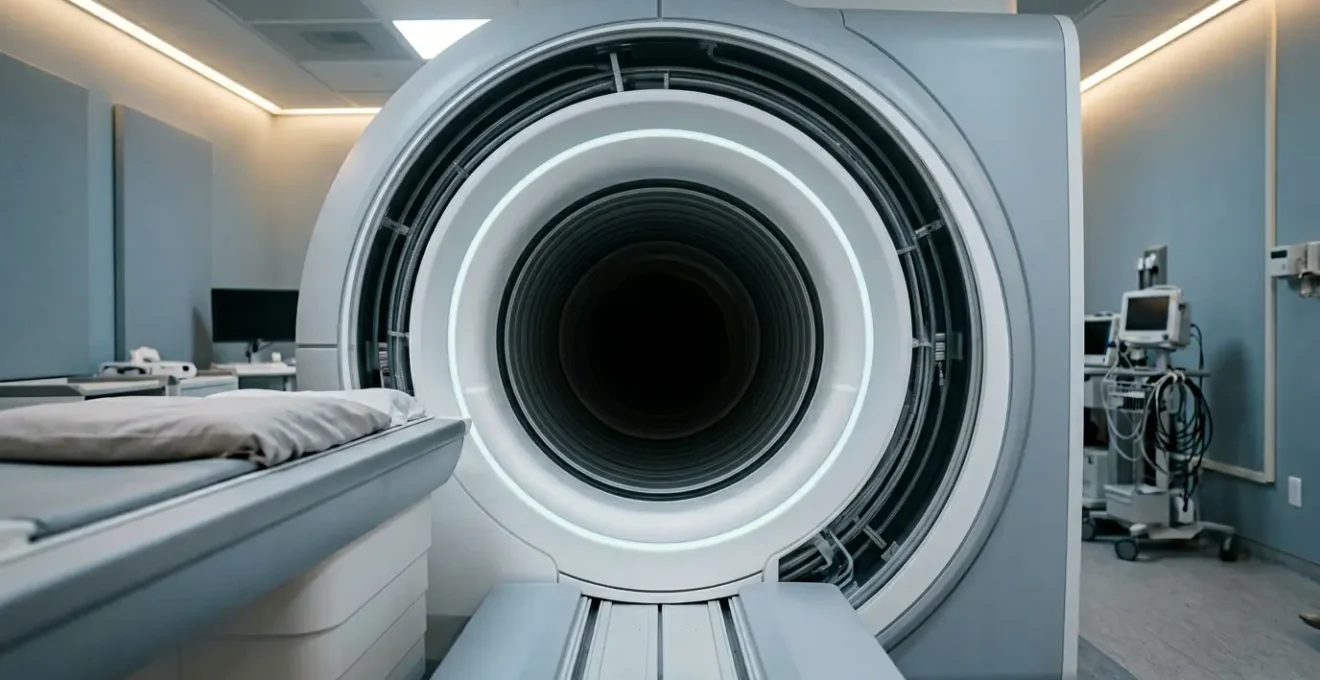
The key to diagnosing chronic headaches isn’t just getting any scan; it’s getting the *right* one, and an MRI’s ability to see soft tissue detail is fundamentally superior to a CT for this purpose.
- MRI uses powerful magnets to visualize the water within your brain cells, providing unmatched clarity of nerves, white matter, and subtle abnormalities a CT’s X-rays would miss.
- For a patient in Montreal, understanding the trade-offs between the public (RAMQ) and private systems is crucial for getting this essential scan in a timely manner.
Recommendation: Use this guide to have a more informed discussion with your doctor and confidently choose the fastest, most effective diagnostic pathway for your specific needs.
Living with chronic headaches brings a heavy burden of uncertainty. Beyond the physical pain, there’s the persistent question: “What if it’s something serious?” You hear about different types of brain scans, mainly CTs and MRIs, but the distinction is often blurry. Many assume they are interchangeable tools, with the main difference being cost or availability. This is a common and potentially misleading simplification. As a radiologist, I can tell you that when it comes to the intricate, delicate structures of the brain responsible for issues like persistent headaches, these two technologies are not just different—they speak entirely different languages.
A CT (Computed Tomography) scan is a master of seeing bone and acute issues like a major bleed. It uses X-rays, essentially creating a high-speed, detailed anatomical map. An MRI (Magnetic Resonance Imaging), however, does something far more subtle and profound. It doesn’t just look at structure; it listens to the behavior of water molecules (specifically, hydrogen protons) inside your tissues when they are placed in a strong magnetic field. This ability to differentiate tissues based on their water content is what gives MRI its unparalleled tissue contrast resolution. It allows us to see the brain’s white matter, nerves, and tiny areas of inflammation with a clarity a CT scan simply cannot achieve.
But if you’re a patient in Montreal, knowing the physics is only half the battle. The other half is navigating our unique healthcare landscape. The choice between waiting months in the public system or paying for a private scan is a significant one. This guide is designed to empower you with both pieces of the puzzle. First, we’ll demystify the technology itself, from contrast agents to what that loud banging noise really means. Then, we will provide a practical roadmap to getting the right scan in Montreal, helping you turn your anxiety into an actionable plan.
This article breaks down the essential information you need to understand your options. Follow along as we explore the specifics of MRI technology and the practical steps for accessing it in the Montreal area.
Summary : Your Complete Guide to Understanding and Accessing Brain MRIs in Montreal
- Gadolinium Contrast: Is It Safe for Patients with Kidney Issues?
- How to Survive a 45-Minute Brain MRI If You Are Claustrophobic?
- What Does ‘White Matter Hyperintensities’ Mean on Your Radiology Report?
- The Specific Lesion Patterns That Confirm Multiple Sclerosis
- How to Find a Private MRI Appointment in Montreal in Under 48 Hours?
- Why the Louder MRI Machine Often Gives Better Pictures?
- Public Hospital vs Private Clinic: Which Path Suits Your Urgency?
- 1.5T vs 3T MRI: Which Machine Is Needed for a Complex Brain Scan?
Gadolinium Contrast: Is It Safe for Patients with Kidney Issues?
For certain diagnostic questions, your radiologist may recommend an MRI “with contrast.” This involves injecting a gadolinium-based contrast agent (GBCA) into a vein, usually in your arm. This substance helps to highlight specific areas of the brain, such as blood vessels, inflammation, or tumors, making them stand out much more clearly on the final images. It’s an essential tool for increasing the diagnostic certainty of the scan, particularly when looking for active inflammation or assessing the blood-brain barrier.
A common and valid concern, however, is the safety of these agents, especially for individuals with pre-existing kidney problems. In the past, older types of gadolinium agents were linked to a rare but serious condition called Nephrogenic Systemic Fibrosis (NSF) in patients with severe kidney disease. This history has led to cautious and well-defined safety protocols across all imaging centers in Montreal and worldwide. It’s crucial to know that the technology and agents have evolved significantly.
Today, modern “Group II” GBCAs are used, which are much more stable and carry a dramatically lower risk. For patients with impaired kidney function, a simple blood test measuring your estimated Glomerular Filtration Rate (eGFR) is performed before the scan. This allows the medical team to assess kidney function and select the safest course of action. In fact, for patients with even severely reduced kidney function (eGFR <30), recent consensus statements show the overall risk of NSF is exceedingly low, around 0.07%. Your medical history will always be reviewed thoroughly to ensure maximum safety.
Therefore, while the concern is understandable given historical context, current protocols and modern agents make gadolinium contrast a very safe procedure for the vast majority of patients, even those with kidney issues, when appropriate screening is performed.
How to Survive a 45-Minute Brain MRI If You Are Claustrophobic?
The thought of being inside a narrow tube for the better part of an hour is a major source of anxiety for many patients. Claustrophobia is a real and significant barrier to getting a necessary MRI scan. The enclosed space, combined with the loud noises, can be overwhelming. However, there are many effective strategies and resources, particularly in Montreal, designed to help you manage this anxiety and successfully complete your scan.
Firstly, communication is key. Inform the clinic staff about your claustrophobia when you book the appointment. They are highly experienced in handling anxious patients and can offer support. On the day of the scan, the technologist can maintain verbal contact with you via an intercom and provide a “panic button” that you can press at any time to stop the procedure. Simple techniques like keeping your eyes closed, practicing slow, deep breathing, or trying to visualize a peaceful, open space can also be remarkably effective. Some patients find it helpful to ask their referring doctor for a mild sedative to take before the appointment.
As you can see, modern scanners are also being designed with patient comfort in mind. Many private clinics and some hospitals in Montreal offer wide-bore MRI machines, which have a larger opening and are less confining than traditional scanners. This extra space can make a world of difference. Furthermore, local institutions are proactive in patient education.
Case Study: The Montreal Neurological Institute’s Patient Preparation Program
The Neuro (Montreal Neurological Institute-Hospital) has developed a comprehensive MRI preparation video as part of a patient-focused initiative. This program allows patients to virtually walk through the entire process before their scan, from the waiting area to seeing the machine itself and hearing the sounds it makes. This process of familiarization has been shown to significantly reduce anxiety and improve scan completion rates for claustrophobic individuals. The facility also prioritizes access to accommodations like wide-bore machines when they are available for clinical use.
Ultimately, knowing what to expect and having a toolbox of coping mechanisms can empower you to get through the scan. The medical team’s goal is the same as yours: to get high-quality images in the most comfortable way possible.
What Does ‘White Matter Hyperintensities’ Mean on Your Radiology Report?
Receiving a radiology report can feel like trying to decipher a foreign language. One of the most common, and often alarming, findings on a brain MRI report is the term “white matter hyperintensities” (WMH). In simple terms, these are small, bright spots that appear on certain MRI sequences (like the FLAIR or T2-weighted images). They represent areas where there is slightly more water content than in the surrounding healthy brain tissue. But what do they actually mean?
The significance of WMH depends almost entirely on their size, location, and, most importantly, your age and clinical context. For many people, especially over the age of 50, a few scattered, small “punctate” hyperintensities are a normal and benign part of the aging process. They are often compared to “wrinkles on the inside” and are typically of no clinical concern. They can be related to minor changes in small blood vessels over time. The key is to differentiate these common age-related findings from more concerning patterns that might indicate an underlying disease.
A radiologist analyzes these spots based on established criteria. Are they clustered around the brain’s ventricles (periventricular)? Are they large and merging together (confluent)? Do they follow a specific orientation relative to the brain’s structures? The answers to these questions help determine the next steps, which are often very different depending on the pattern observed. In Montreal, the diagnostic pathway is well-established based on these findings.
The following table, based on common radiological practice in Montreal, helps illustrate how these findings are interpreted and what the typical next steps are.
| Finding Type | Typical Age Group | Clinical Significance | Next Steps in Montreal |
|---|---|---|---|
| Small punctate hyperintensities | 50+ years | Usually benign aging | No referral needed |
| Periventricular caps | 60+ years | Common, non-specific | Follow-up with family doctor |
| Confluent lesions | Any age | May indicate vascular disease | Referral to neurologist (3-6 month wait) |
| Dawson’s fingers pattern | 20-40 years | Suggestive of MS | Urgent referral to MS Clinic at The Neuro |
Seeing “white matter hyperintensities” on your report is not automatically a cause for panic. Context is everything, and these findings are a perfect example of why an MRI report should always be interpreted by your referring physician in the context of your overall health.
The Specific Lesion Patterns That Confirm Multiple Sclerosis
While many things can cause white matter hyperintensities, certain patterns are highly suggestive of Multiple Sclerosis (MS), an autoimmune disease that affects the central nervous system. For a patient being investigated for MS, the MRI is not just a tool; it is the cornerstone of diagnosis. Radiologists and neurologists look for very specific evidence of lesions that show “dissemination in space” and “dissemination in time.”
Dissemination in space (DIS) means finding lesions in at least two characteristic locations in the central nervous system, such as periventricular (around the ventricles), juxtacortical (near the cortex), infratentorial (in the brainstem or cerebellum), or in the spinal cord. Finding spots in multiple of these key areas makes a diagnosis of MS much more likely than if they were all confined to one region. Patterns like “Dawson’s fingers,” which are lesions oriented perpendicularly to the ventricles, are a classic sign.
Dissemination in time (DIT) is the second crucial piece of evidence. This means demonstrating that new lesions have appeared over time, or that some lesions are actively inflamed while others are old and inactive. This can be confirmed in two ways: either by finding a new lesion on a follow-up MRI scan that wasn’t there on a previous one, or by seeing simultaneous gadolinium-enhancing (active) and non-enhancing (old) lesions on a single scan. This confirmation of ongoing disease activity over time is a hallmark of MS.
Case Study: The Diagnostic Approach at Montreal’s MS Clinic
The Multiple Sclerosis Clinic at The Neuro (Montreal Neurological Institute) is the oldest and one of the most respected MS centers in Canada. As a Level-4 accredited facility, the clinic uses advanced 3T MRI technology to meticulously apply the McDonald Criteria, the international standard for diagnosing MS. A key part of their process is the ability to import and compare previous scans, even those from private clinics across Montreal. This is critical for demonstrating dissemination in time, as a new lesion appearing on a scan performed at The Neuro compared to a private scan from six months prior can be the definitive evidence needed to confirm a diagnosis and start treatment promptly.
This rigorous, evidence-based approach ensures that a diagnosis of MS is made with the highest possible degree of certainty, allowing patients to access the correct care pathway as quickly as possible.
How to Find a Private MRI Appointment in Montreal in Under 48 Hours?
One of the most stressful realities for patients in Montreal is the wait time for diagnostic imaging in the public system. For a non-urgent brain MRI for something like chronic headaches, the wait can be anywhere from 6 to 12 months, or even longer. This long period of uncertainty is difficult for anyone to endure. For this reason, many patients choose to explore the private healthcare system to get answers more quickly.
In Montreal, a vibrant network of private imaging clinics offers MRI appointments, often within days or even hours of your call. While this comes at a cost—typically not covered by the Régie de l’assurance maladie du Québec (RAMQ)—the speed can provide invaluable peace of mind and a faster route to diagnosis and treatment. The process of booking a private scan is surprisingly straightforward if you know the steps.
The first and most important requirement is a medical requisition. This is a referral form from a licensed physician in Quebec. You can get this from your family doctor, a specialist, or even a physician at a walk-in clinic. Once you have this requisition in hand, the process of finding and booking an appointment is in your control. The key is to be prepared when you make the call to have all necessary information ready.
Your Action Plan: Booking a Private MRI in Montreal
- Obtain a Requisition: Get a valid MRI referral from any doctor licensed in Quebec. This can be your family doctor or a physician from a walk-in clinic.
- Contact Private Providers: Research and call major private clinics in the Montreal area. For example, DiagnostiX Montreal often offers appointments within a few days, and some clinics may accept patients even without an immediate doctor’s referral for specific scans.
- Have Information Ready: When you call, have your Quebec health card (for identification), the details on your requisition, and a list of your preferred appointment times.
- Confirm Costs: Ask for the exact price. A brain MRI without contrast typically costs between $750 and $950. This is an out-of-pocket expense and is not covered by RAMQ.
- Inquire About Report Delivery: Confirm how and when the results will be delivered. Most private clinics send the official report directly to your referring doctor within 48-72 hours and provide you with digital access to your images.
By following these steps, you can take control of your diagnostic timeline, significantly reducing the waiting period and the anxiety that comes with it. This allows you to bring a definitive report back to your doctor and move on to the next stage of your care plan.
Why the Louder MRI Machine Often Gives Better Pictures?
For anyone who has had an MRI, the most memorable part is often the noise: a loud, rhythmic series of banging, buzzing, and clanking sounds. It can be unsettling, and many patients wonder why such an advanced piece of medical technology has to be so loud. The answer lies in the fundamental physics of how an MRI creates an image, and surprisingly, that noise is a direct sign that the machine is working hard to generate high-quality pictures.
An MRI machine’s main component is a huge, powerful magnet that creates a stable magnetic field, causing the protons in your body’s water molecules to align themselves. To create an image, we need to disrupt this alignment in a very precise way. This is done using smaller magnets called gradient coils. These coils are switched on and off thousands of times per second, altering the magnetic field in tiny increments. This rapid switching causes the coils to vibrate, and it’s this vibration inside the main magnet housing that produces the loud banging noise. The faster and stronger the gradients switch, the louder the noise.
So, why is this important for picture quality? The strength and speed of these gradients directly relate to the image’s resolution and the speed of the scan. A more powerful (and thus, louder) system can create more detailed images in a shorter amount of time. This is directly related to the Signal-to-Noise Ratio (SNR). A higher SNR means a clearer picture with less graininess, allowing radiologists to spot smaller details. Louder, more intense gradient switching generates a stronger signal, improving the SNR and, consequently, the diagnostic quality of the scan. As leading experts in the field confirm, this power is key.
The powerful magnetic field of this new scanner is already providing researchers with unprecedented views of the brain and spinal cord.
– Dr. Guy Rouleau, Director of The Neuro – McGill University announcement
Therefore, the next time you’re in an MRI, you can reframe the experience: that industrial noise isn’t a flaw in the design, but the sound of the machine working at its peak to capture the incredibly detailed images needed for your diagnosis. It’s the sound of clarity being created. This is especially true as Montreal’s top institutions, such as the McConnell Brain Imaging Centre, operate both 3T Siemens Prisma and cutting-edge 7T Terra systems.
Public Hospital vs Private Clinic: Which Path Suits Your Urgency?
In Quebec, patients are fortunate to have a public healthcare system (RAMQ) that covers the cost of medically necessary MRIs. However, the high demand and limited resources mean that access is triaged based on urgency, leading to significant wait times for non-emergency cases. This creates a critical decision point for patients in Montreal: wait in the public system or pay out-of-pocket for a private scan? The right choice depends entirely on your specific situation, balancing urgency, finances, and your tolerance for uncertainty.
The public system excels in handling emergencies and highly urgent cases. If a patient presents at an emergency room with symptoms of a stroke or a suspected brain tumor, they will receive an MRI very quickly. For semi-urgent or non-urgent cases, such as monitoring a known condition like MS or investigating chronic headaches, the waitlist is where the challenge lies. These waits can stretch from a few months to over a year, a difficult prospect when you are seeking answers and relief.
This is where the private system offers an alternative. Private clinics in Montreal operate outside the RAMQ framework for these scans, allowing them to offer appointments with virtually no wait time. For a price, a patient can often secure a scan within 24 to 48 hours. This speed is the primary benefit, offering immediate peace of mind and a faster path to a diagnosis. The following matrix outlines the typical scenarios:
This table clearly shows the trade-offs a patient in Montreal must consider when deciding between the public and private imaging pathways.
| Urgency Level | Condition Example | Public Wait (RAMQ) | Private Timeline | Cost Difference |
|---|---|---|---|---|
| Emergency | Acute stroke symptoms | Immediate | Not applicable | $0 (RAMQ) |
| Urgent | Suspected tumor | 2-4 weeks | 24-48 hours | $750-950 private |
| Semi-urgent | MS monitoring | 2-3 months | 1-3 days | $750-950 private |
| Non-urgent | Chronic headaches | 6-12+ months | Same week | $750-950 private |
Interestingly, many Montrealers opt for a “hybrid” approach, which leverages the best of both systems. This strategy is not only common but also fully accepted by the public healthcare system.
The Hybrid Path: Using Private Diagnosis for Public Treatment
Many patients in Montreal choose a hybrid strategy: they obtain a private MRI scan, paying out-of-pocket to get a diagnosis in days rather than months. They then take the images and the radiologist’s report from the private clinic back to their physician within the public system. This allows them to “jump the queue” for the diagnostic step, and if treatment is needed, it can be initiated much sooner within the RAMQ-covered system at major hospitals like the MUHC or CHUM. This approach effectively reduces diagnostic delays from months to days while preserving access to public healthcare for all subsequent treatment and follow-up.
Ultimately, the choice is yours. There is no right or wrong answer, only the path that best suits your medical needs, your financial situation, and your personal comfort level with waiting.
Key Takeaways
- An MRI’s superiority for soft tissue comes from its use of magnetism to see water in brain cells, offering detail a CT’s X-rays cannot match.
- In Montreal, wait times for a non-urgent brain MRI in the public system can exceed 6-12 months, making the private option (24-48 hours) an important alternative for faster diagnosis.
- Understanding your MRI report, including terms like “white matter hyperintensities,” is crucial, as their significance depends heavily on size, location, and your age.
1.5T vs 3T MRI: Which Machine Is Needed for a Complex Brain Scan?
Once you’ve decided to get an MRI, you might encounter another layer of complexity: not all MRI machines are the same. The primary differentiator is the strength of the main magnet, measured in a unit called the Tesla (T). Most clinical MRI scanners in Montreal and around the world are either 1.5T or 3T. While a 1.5T machine is an excellent and powerful tool for a wide range of diagnostic tasks, a 3T machine offers specific advantages for more complex cases.
Think of magnet strength like the resolution on a camera. A 1.5T MRI is the workhorse of modern radiology. It provides excellent, high-quality images for the vast majority of clinical needs, including routine brain scans for headaches, follow-up for a concussion, or imaging of the spine and joints. Most community hospitals and private clinics in Montreal are equipped with 1.5T scanners, making them widely accessible.
A 3T MRI, on the other hand, has a magnetic field that is twice as strong. This doubling of field strength doesn’t just double the image quality; it significantly increases the Signal-to-Noise Ratio (SNR). This results in images that are much clearer, with higher resolution and greater detail. This level of precision is not always necessary, but it becomes critical for certain complex neurological questions. For example, 3T is superior for detecting the subtle, small lesions of early Multiple Sclerosis, providing detailed pre-surgical mapping of the brain’s functional areas, or pinpointing the origin of seizures in epilepsy. This is why these powerful machines are often reserved for specific situations.
3T machines for RAMQ-covered scans are located at major university centers and are reserved for complex cases.
– McConnell Brain Imaging Centre, MRI Unit Research Capabilities
In Montreal, this means that if you need a 3T scan through the public system, you will likely be referred to a major university hospital like the MUHC, the CHUM, or The Neuro. For the investigation of chronic headaches, a 1.5T MRI is almost always sufficient. However, if your initial scan suggests a more complex issue, your neurologist may specifically request a follow-up on a 3T scanner to get the highest level of detail possible. (An even stronger 7T machine exists at The Neuro, but it is currently used exclusively for research purposes).
Armed with this knowledge, you can have a much more productive conversation with your doctor. You can ask not just “Do I need an MRI?” but “Is a 1.5T scan sufficient for my symptoms, or would the detail of a 3T be beneficial?” This positions you as an active, informed partner in your own healthcare journey.