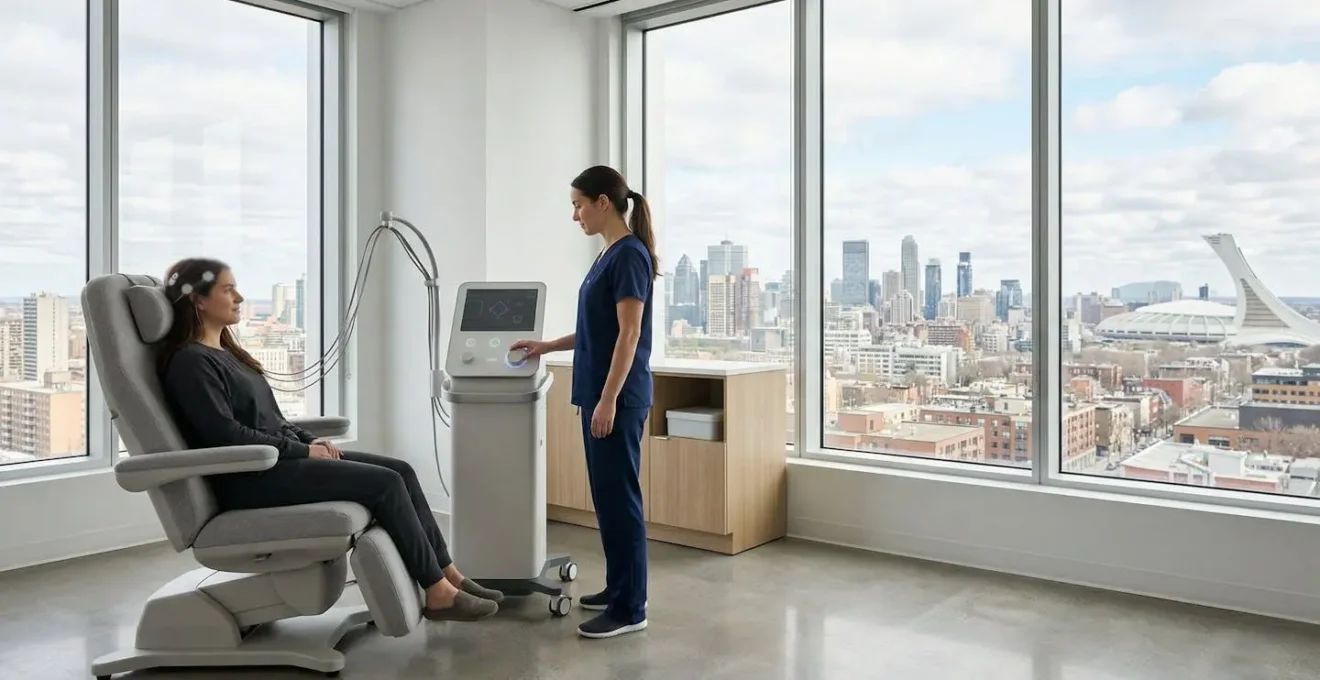
For those with chronic pain, the goal isn’t just to mask signals with medication; it’s to fundamentally retrain the brain’s response to pain.
- Neurostimulation technologies like TMS and SCS work by modulating neural pathways, effectively teaching the brain to process pain differently, rather than just blocking it chemically.
- While RAMQ coverage is limited, private insurance and specific financing options in Montreal make these advanced, non-opioid treatments increasingly accessible.
Recommendation: The most crucial step is to shift your mindset from passively managing pain to actively retraining your neural software, a conversation you can and should initiate with your doctor.
Living with chronic pain in Quebec can feel like a relentless cycle. You follow your doctor’s advice, you try the prescribed painkillers, and for a while, they might offer a semblance of relief. But then their effectiveness wanes, the side effects become a burden, or you simply hit a wall where increasing the dosage is no longer a viable or safe option. It’s a frustrating and isolating experience, leaving many to believe they’ve run out of road. The conventional approach often focuses on medication that acts as a temporary roadblock for pain signals, a chemical patch on a complex neurological issue.
But what if the solution wasn’t about building a better roadblock, but about rerouting the traffic entirely? The true frontier in pain management isn’t a stronger pill; it’s a deeper understanding of the brain’s own operating system. This is the core principle of neurostimulation. It’s not about masking pain. It’s about a fundamental process of brain retraining, using targeted energy to help your central nervous system unlearn the chronic pain loops it’s stuck in. This approach is about rewiring the neural software itself, offering a path to lasting relief when the chemical “hardware” of medication has failed.
This guide is designed for you—the chronic pain sufferer in Quebec who is looking for what’s next. We will move beyond the simple idea of “alternatives” and explore how these technologies work, what they feel like, and, crucially, how you can navigate the practical steps of accessing them here in Montreal and across the province. We’ll demystify the science, address the real-world questions of cost and coverage, and empower you to have a new kind of conversation with your healthcare provider—one about reclaiming control.
To help you navigate these advanced options, this article breaks down the key aspects of neurostimulation, from specific treatments and their side effects to the practicalities of insurance coverage in Quebec and how to discuss these therapies with your doctor.
Summary: Rewiring Your Brain for Pain Relief: A Quebecer’s Guide
- TMS vs Antidepressants: Which Has Fewer Side Effects for Treatment-Resistant Depression?
- Spinal Cord Stimulator Implant: Is the Surgery Worth the Risk for Back Pain?
- What Does Neurostimulation Actually Feel Like During a Session?
- Is rTMS Covered by RAMQ or Private Insurance in Quebec?
- When Does the Effect of Neurostimulation Start to Fade?
- VR Headsets vs Morphine: Using Tech to Manage Burn Victim Pain?
- How to Talk to Your Doctor About Stopping Medications You No Longer Need?
- Why an MRI of the Central Nervous System Is More Detailed Than a CT Scan?
TMS vs Antidepressants: Which Has Fewer Side Effects for Treatment-Resistant Depression?
Chronic pain and depression are often intertwined, creating a vicious cycle where each condition exacerbates the other. For many Quebecers, the first line of defense is antidepressants, which can help but often come with a host of systemic side effects like weight gain, fatigue, and emotional blunting. When these medications fail, it’s known as treatment-resistant depression, a common challenge for those also managing chronic pain. This is where Transcranial Magnetic Stimulation (TMS) presents a paradigm shift. Instead of a chemical that affects the entire body, TMS is a non-invasive therapy that uses targeted magnetic pulses to stimulate specific regions of the brain associated with mood regulation.
The primary advantage of TMS lies in its precision. The treatment is delivered externally, directly to the prefrontal cortex, without affecting the rest of the body. Consequently, the side effects are typically mild and localized, such as a temporary headache or scalp discomfort during the session. Unlike antidepressants, there are no systemic side effects, which is a profound benefit for patients already burdened by the physical toll of chronic pain and pain medication. This targeted “brain retraining” approach allows for the direct modulation of neural circuits involved in depression, offering hope without the trade-offs of systemic drugs.
For those considering this path, navigating the financial aspect is a key step. While RAMQ coverage is limited, many private insurers are beginning to recognize the value of TMS. Here are the key steps for seeking private coverage:
- Obtain a referral from a psychiatrist or pain specialist documenting your treatment-resistant diagnosis.
- Request a detailed treatment plan from your TMS provider.
- Contact your private insurer (e.g., Sun Life, Desjardins) to verify your mental health coverage limits.
- Submit a pre-authorization request with all medical documentation, including a RAMQ rejection letter if applicable.
- Keep a detailed record of all medication trials and their adverse side effects to build a strong case for medical necessity.
Spinal Cord Stimulator Implant: Is the Surgery Worth the Risk for Back Pain?
For severe, intractable back pain that hasn’t responded to other treatments, a Spinal Cord Stimulator (SCS) represents a more significant, yet potentially life-changing, intervention. Unlike TMS, an SCS is an implanted device. It consists of thin wires (leads) placed in the epidural space near the spinal cord and a small, pacemaker-like battery pack implanted under the skin. The device works by delivering tiny electrical impulses that interfere with the pain signals traveling to the brain, replacing the sensation of pain with a more pleasant tingling or, with newer devices, no sensation at all. This is pain signal modulation at its most direct.
The “surgery” itself is a key consideration. It’s a minimally invasive procedure, but it is still an implant. The major advantage of SCS is the trial period. Before you commit to the permanent implant, you undergo a trial where the leads are placed externally for several days. This allows you and your specialist to determine if the therapy provides adequate pain relief. If the trial is successful, you can proceed with the full implant. This “try before you buy” approach significantly de-risks the decision. According to clinical data, the vast majority of patients report a 50-70% reduction in pain, a level of relief that can be transformative.
This illustration helps visualize how the stimulator is precisely positioned to interrupt pain pathways.
As you can see, the technology is designed to work in harmony with your body’s nervous system. Leading programs across the country, such as the one established by Dr. Aaron Hong at St. Michael’s Hospital in Toronto, which is the largest in Canada, demonstrate the growing success of this therapy. The Canadian Neuromodulation Pain Management Centre (CNPM) in Toronto treats patients from coast to coast, including those covered by provincial workers’ compensation boards like WSIB and Veterans Affairs Canada, highlighting its established credibility as a viable long-term solution.
What Does Neurostimulation Actually Feel Like During a Session?
One of the biggest questions for anyone considering neurostimulation is simple: what does it feel like? The fear of the unknown, especially when it involves the brain or spine, is completely natural. The reality, however, is often much gentler than people imagine. The sensation is highly dependent on the specific technology being used, as each one interacts with the nervous system differently. The goal is never to cause pain, but to create a new sensory input that either masks or retrains the brain’s perception of existing pain. Most of these therapies are designed to be comfortable and easily tolerated.
Dr. Lara Dhingra, writing for Psychology Today Canada, provides a reassuring perspective on the experience of non-invasive methods, highlighting the patient-friendly nature of the process. She states:
Neurostimulation is non-invasive—the headband simply rests on your scalp—no surgery or needles are involved. Most people tolerate it well, and experience only mild itching or tingling that becomes less noticeable after a few minutes.
– Dr. Lara Dhingra, Psychology Today Canada
This description helps to demystify the process, framing it as a manageable and comfortable experience. To provide a clearer picture, the sensations from different common neurostimulation technologies can be compared directly.
| Technology | Sensation Description | Intensity Level | Duration |
|---|---|---|---|
| TMS | Rhythmic tapping like a woodpecker on scalp | Mild to moderate | 20-40 minutes |
| TENS | Gentle tingling or buzzing on skin | Adjustable | 15-60 minutes |
| SCS | Mild electrical buzzing replacing pain signals | Customizable | Continuous option |
| tDCS | Slight itching or tingling that fades | Very mild | 20-30 minutes |
As the table shows, the feelings range from a light tapping to a gentle buzz. For implanted devices like SCS, the intensity is customizable by the patient, giving you direct control over your therapy. This sense of agency is a powerful component of the treatment itself, marking a significant departure from the passive experience of taking a pill.
Is rTMS Covered by RAMQ or Private Insurance in Quebec?
For any Quebecer exploring advanced pain therapies, the question of cost and coverage is paramount. The landscape for repetitive Transcranial Magnetic Stimulation (rTMS) in Quebec is complex. As of now, RAMQ coverage for rTMS remains limited to hospital-based research protocols only. This means that for the vast majority of patients seeking it for chronic pain or depression, treatment in a private clinic is not covered by the public system. This can feel like a significant barrier, but it’s not the end of the story.
The private sector in Montreal has stepped up to fill this gap. Many private insurance plans through employers (like those with Desjardins, Sun Life, or Canada Life) offer coverage for mental health treatments, and rTMS is increasingly being included. Success often depends on demonstrating that other, more traditional treatments have failed. Furthermore, private clinics themselves offer solutions to make the therapy more accessible. The environment in these modern clinics is designed to be calming and professional, a far cry from a sterile hospital setting, which helps in managing the psychological aspects of treatment.
If you’re facing out-of-pocket costs, don’t lose hope. There are several avenues to explore for funding in the Montreal area:
- Clinical Trials: Institutions like the Douglas Research Centre or The Neuro (McGill University’s Montreal Neurological Institute-Hospital) often recruit for studies that provide treatment at no cost.
- Payment Plans: Clinics such as Neurotherapy Montreal offer flexible payment plans and financing options to spread out the cost over time.
- Tax Credits: Medical expenses, including rTMS, are eligible for both Quebec and Federal Medical Expense Tax Credits. This can result in a significant refund (often up to 15% federally and 20% provincially) when you file your taxes.
- Employer Programs: Check if your workplace’s Employee Assistance Program (EAP) has a budget for mental health or pain management treatments.
- Compassionate Care: Some private clinics have compassionate care programs for individuals demonstrating significant financial hardship.
When Does the Effect of Neurostimulation Start to Fade?
Unlike a pill that works for a few hours, neurostimulation aims for lasting change. However, it’s not always a permanent “cure.” The goal is durable, long-term relief, and understanding the timeline is key to setting realistic expectations. The duration of effectiveness varies based on the individual, the condition being treated, and the specific technology used. For many, an initial course of treatment, such as a series of TMS sessions, can produce significant relief that needs to be maintained over time.
The concept of “fading” is better understood as the brain’s natural tendency to revert to old patterns. This is why a long-term strategy is crucial. For many patients undergoing treatments like rTMS, clinical data shows relief typically lasts for 6-12 months for about 60% of patients after an initial course of therapy. When the effects begin to diminish, it doesn’t mean the treatment has failed. Instead, it signals the need for “maintenance” or “booster” sessions. These are typically much less frequent than the initial treatment protocol—perhaps one session every month or two—to reinforce the new, healthier neural pathways that were established.
This is where an integrated approach, as practiced by leading clinics in Montreal, becomes so important. A case example is the protocol at Neurotherapy Montreal. They emphasize that the best and most durable results are achieved when neurostimulation is not used in isolation. Their interdisciplinary model combines neurostimulation with other modalities like physiotherapy and psychological support. By having all healthcare professionals in frequent communication, they can create a synergistic effect, optimizing long-term pain management and extending the duration of relief far beyond what a single therapy might achieve. This transforms the treatment from a one-time fix into a continuous, adaptive management plan—a true therapeutic partnership.
VR Headsets vs Morphine: Using Tech to Manage Burn Victim Pain?
The idea of using a VR headset to manage the excruciating pain of burn victims sounds like science fiction, but it’s a real and powerful example of a broader shift in medicine: using technology to engage the brain instead of just flooding the body with drugs like morphine. This principle extends across many forms of neuro-tech. It’s not about masking a symptom; it’s about changing the brain’s fundamental processing of it. While VR distracts the brain, other neurostimulation technologies go a step further by aiming to restore normal function to the nerves and muscles at the heart of the pain.
A prime example of this restorative philosophy is ReActiv8, a neurostimulation system designed for chronic low back pain caused by a dysfunctional multifidus muscle. This deep spinal muscle is crucial for stability, and when it doesn’t function correctly, it can lead to debilitating pain. Traditional approaches might involve painkillers or surgery, but ReActiv8 takes a different route. It uses implanted electrodes to stimulate the nerve that controls this muscle, effectively “waking it up” and retraining it to function properly over time.
Dr. Gilligan, commenting on this technology for an IEEE publication, perfectly captures this paradigm shift. He explains that the device isn’t just covering up pain signals. As he puts it:
This is not covering up any sensation. This device is working by restoring the function of the multifidus. You are restoring stability and if you restore stability, then the pain is going away.
– Dr. Gilligan, IEEE Pulse
This is the essence of “brain retraining” applied to the neuromuscular system. By fixing the underlying functional problem, the pain resolves as a consequence. Studies on this restorative approach are promising; an analysis of ReActiv8 studies showed that 58% of chronic back pain patients responded positively, regaining function and reducing their pain. This illustrates a hopeful future where technology helps the body heal itself, rather than just silencing its cries for help.
How to Talk to Your Doctor About Stopping Medications You No Longer Need?
Initiating a conversation about reducing or “deprescribing” pain medication, especially opioids, can be intimidating. Many patients fear being seen as non-compliant or worry their doctor will think they are questioning their judgment. However, when you are actively exploring effective alternatives like neurostimulation, this conversation becomes a collaborative step towards a better quality of life. The key is to frame it not as a rejection of past treatment, but as a proactive and informed evolution of your care plan. You are not just asking to stop medication; you are proposing to replace it with a new, promising therapy.
In Quebec, this conversation is particularly powerful when you involve your entire healthcare team, especially your pharmacist, who is an accessible expert in medication management. Arriving prepared for your appointment with a clear plan can transform the dynamic from a simple request into a strategic discussion. Patient testimonials often highlight this transition as a pivotal moment of reclaiming agency over their health. As one patient described their experience with neurostimulation, the treatment allowed them to “significantly reduce or eliminate their dependence on opioids” and stop living hour by hour, spacing out pain medication. This is the goal you are working towards.
Having a structured plan can make the conversation with your doctor feel less daunting and more productive. It shows you’ve done your research and are a serious partner in your own healthcare.
Your Action Plan for a Deprescribing Conversation
- Initiate the Topic: Start the conversation clearly and positively. Say something like, “I’d like to discuss reducing my pain medication as I explore neurostimulation options that are showing success.”
- Present Your Research: Bring a summary of your findings on neurostimulation for your specific condition. Mentioning success rates or specific technologies shows you’re an informed patient.
- Propose a Collaborative Timeline: Suggest a gradual approach. For instance, “Could we create a 3-month tapering schedule that runs in parallel with my trial of neurostimulation?”
- Involve Your Pharmacist: Explicitly state your intention to collaborate. “I plan to work closely with my pharmacist to follow the tapering protocol and manage any withdrawal symptoms.”
- Commit to Documenting Progress: Show you will be an active participant. “I will keep a detailed pain and activity diary to track my response to both the medication reduction and the new therapy.”
Key Takeaways
- Neurostimulation is not a pain blocker, but a form of “brain retraining” that modifies the neural pathways causing chronic pain.
- For Quebecers, while RAMQ coverage is limited, private insurance, tax credits, and clinic financing plans provide viable paths to accessing these therapies.
- Success is greatest when neurostimulation is part of an integrated, long-term plan including maintenance sessions and complementary therapies like physiotherapy.
Why an MRI of the Central Nervous System Is More Detailed Than a CT Scan?
Before any effective treatment for chronic pain can begin, a precise diagnosis is essential. For issues involving the central nervous system—the brain and spinal cord—Magnetic Resonance Imaging (MRI) is the undisputed gold standard. While a Computed Tomography (CT) scan is excellent for viewing bones and urgent issues like a major bleed, it uses X-rays and provides less detail of soft tissues. An MRI, on the other hand, uses powerful magnets and radio waves to generate incredibly detailed images of nerves, discs, the spinal cord, and the brain itself. It can reveal subtle disc herniations, nerve compression, or changes in brain tissue that a CT scan would completely miss. This level of detail is critical for guiding treatment, especially for advanced therapies like SCS or for ruling out other causes of pain.
However, for anyone in Montreal navigating the public healthcare system, this diagnostic superiority comes with a significant challenge: wait times. While an MRI is a non-urgent procedure in most cases, the delays can be agonizing when you’re living in constant pain. According to a report in the Canadian Medical Association Journal, in Montreal’s public facilities, wait times range from 2 weeks to 14 months, depending on the urgency assigned to your case. This long, uncertain wait can be a major source of stress and can delay your path to relief.
Fortunately, this is another area where taking control is possible. Quebec’s healthcare system allows for a two-tier approach, and private MRI clinics in the Montreal area offer an alternative for those who can’t or don’t want to wait. The cost can be a factor, but many private insurance plans may offer partial or full coverage. Understanding the trade-offs between the public and private systems is key to making an informed choice.
| Clinic Type | Cost Range (CAD) | Wait Time | Coverage |
|---|---|---|---|
| Public Hospital | $0 | 2-14 months | RAMQ covered |
| Private Clinic (Standard) | $550-$900 | 1-2 weeks | Private insurance may cover |
| Private Clinic (Express) | $900-$1,400 | 24-72 hours | Out of pocket |
| US Border Clinics | $400-$900 USD | 1-7 days | Some insurance coverage |
Choosing to go private is a personal decision based on finances, insurance, and the severity of your pain. However, knowing that you have the option to get a definitive diagnosis in days rather than months is an empowering first step in your journey. It allows you to move forward with a clear, data-driven treatment plan, putting you back in the driver’s seat of your own healthcare.
By understanding that neurostimulation is about actively retraining your brain, you can shift from being a passive recipient of treatment to an active partner in your own recovery. The technologies are here, the expertise is available in Quebec, and the path forward, while requiring effort, is clearer than ever. The next step is to begin the conversation and explore which of these advanced options is the right fit for your unique journey toward a life with less pain.