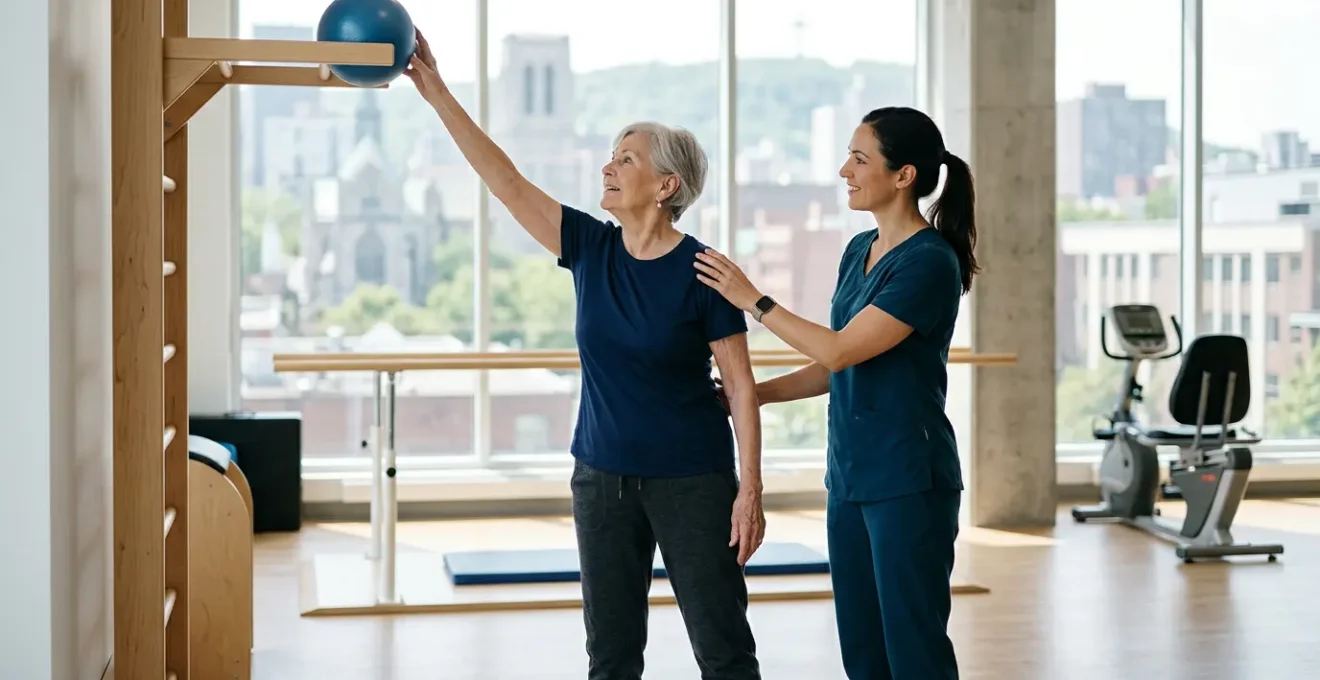
The goal of rehabilitation isn’t to rewind the clock to a pre-injury body, but to masterfully redesign your daily life to thrive with the body you have now.
- Functional rehabilitation focuses on practical skills (cooking, dressing, navigating your home) over abstract exercises.
- It prioritizes adapting your environment and using specific tools to restore autonomy quickly and safely.
Recommendation: Shift your focus from “100% recovery” to building a “functional toolkit” that allows you to confidently reclaim the activities that matter most to you.
After an injury, surgery, or health event, the path to recovery can feel like a steep mountain to climb. The prevailing advice often centers on “getting back to 100%” through rigorous physiotherapy exercises. We’re told to push harder, stretch further, and focus on regaining the strength and mobility we once had. This is the world of standard physiotherapy, a crucial discipline focused on healing and strengthening specific muscles and joints. It’s an essential part of the healing process, and its value is undeniable.
But what if you’ve been doing the exercises diligently, yet the simple act of making breakfast or walking to the corner dépanneur still feels like a monumental task? This is a common frustration, and it points to a gap in the traditional approach. The problem isn’t a lack of effort; it’s a difference in focus. While physiotherapy rebuilds the body’s raw capacity, another, more holistic approach is needed to translate that capacity into real-world independence.
This is where functional rehabilitation comes in. It starts with a different question: not “How do we fix this joint?” but “What do you want to be able to do in your life today?” This guide reframes the entire concept of recovery. We will move beyond the idea of simply fixing a part of the body and instead explore a strategy of life design—a practical, empowering method for rebuilding your autonomy, right here in your Montreal home. We will explore why the “100% recovery” mindset can be a trap, how to leverage your home as your greatest therapeutic tool, and how to navigate Quebec’s healthcare system to get the support you truly need.
This article will guide you through the core principles of functional rehabilitation, offering practical steps and local Montreal resources to help you reclaim not just movement, but your life’s activities. Let’s explore how to build a recovery that fits your world.
Summary: A Practical Guide to Functional Recovery for Montreal Seniors
- Why Aiming for ‘100% Recovery’ Can Sabotage Your Rehab Progress?
- Home Exercises vs Clinic Sessions: Which Yields Better Motor Skill Recovery?
- The 3 Adaptive Tools That Allow You to Dress Alone After Shoulder Surgery
- How to Break Through the ‘Recovery Plateau’ After 3 Months of Rehab?
- Does RAMQ Cover Bath Seats and Walkers for Home Rehabilitation?
- How to Build a ‘Health Binder’ That ER Doctors Will Actually Read?
- How to ‘Dementia-Proof’ a Montreal Apartment to Prevent Wandering?
- How to Regain Mobility After a Car Accident When Pain Is Still Present?
Why Aiming for ‘100% Recovery’ Can Sabotage Your Rehab Progress?
As an occupational therapist, I see many individuals fixate on an idealized vision of “full recovery”—a complete return to their physical state before an injury or illness. While admirable, this pursuit can paradoxically become the biggest obstacle to regaining independence. It sets a standard that may no longer be realistic and, more importantly, it distracts from the true goal: restoring function in your daily life.
The core philosophy of functional rehabilitation is to shift the goalpost from abstract perfection to practical achievement. Instead of aiming to lift a certain weight in the gym, we aim to lift a pot of water to the stove. Instead of endless leg lifts, we practice climbing the stairs in your Montreal triplex. This change in mindset is incredibly powerful. In fact, evidence-based research demonstrates that up to 95.6% of rehabilitation patients showed significant improvement when they focused on achieving these functional goals rather than chasing the elusive 100%.
Consider the case of a Montreal senior I worked with, discharged from the hospital feeling weak and discouraged. Instead of focusing on his pre-injury benchmarks, we designed his life and his program around one goal: being able to cook his own meals and visit his daughter who lived on the second floor. Within three months, he was not only navigating his stairs with confidence but was also lifting 15-pound weights—not for the sake of the weight, but because it mimicked the actions needed for his daily life. His success wasn’t measured by a percentage; it was measured in plates cooked and family visits made.
Home Exercises vs Clinic Sessions: Which Yields Better Motor Skill Recovery?
The debate between home-based exercises and in-clinic sessions is a common one. A clinic offers specialized equipment and direct, hands-on supervision. However, the ultimate goal of rehabilitation is not to perform well in a clinic, but to thrive in your own home. This is where functional rehabilitation reveals its greatest strength: it transforms your living space into the most relevant and effective therapy gym you could have.
True motor skill recovery happens when your brain and body learn to navigate the specific challenges of your environment. Practicing on a perfectly flat clinic floor is helpful, but it doesn’t prepare you for the slightly uneven hardwood in your hallway or the specific height of your own bathtub ledge. As the team at Réadaptation Mobile in Montreal notes, the most effective approach is often a hybrid one. They explain that this model “combines in-home visits and virtual sessions to deliver personalized prescriptive exercise programs, helping older adults stay active, independent, and safe” right where they live.
This approach places the focus squarely on environmental competence. Your home is not just a place to do exercises; it’s the context where your recovery becomes real. It allows a therapist to see the actual challenges—the throw rug that’s a tripping hazard, the chair that’s too low, the cupboards that are too high—and integrate solutions directly into your program.
This image of a modern home rehabilitation setup captures the essence of this approach. It shows how technology can bring expert guidance directly into your living space, making every corner of your home part of a meaningful recovery journey.
Ultimately, the question isn’t whether home is better than the clinic, but how to best use both. The clinic can be for diagnosis and intensive, equipment-heavy work. But the home is where you practice the art of living. It’s where you master the specific movements that translate into true, lasting independence.
The 3 Adaptive Tools That Allow You to Dress Alone After Shoulder Surgery
Regaining the ability to dress yourself after shoulder surgery, or any condition that limits your reach and flexibility, is a major milestone in reclaiming your independence. It’s a task we take for granted, yet its loss can be profoundly frustrating. The secret isn’t to force your body into painful movements, but to build a “functional toolkit” with a few simple, brilliant adaptive tools that work around your limitations.
Instead of struggling with a shirt, imagine effortlessly guiding it over your shoulder with a dressing stick. Instead of giving up on wearing socks, picture them sliding on with ease using a sock aid. These aren’t “crutches”; they are intelligent solutions that empower you to remain self-sufficient. Standard physiotherapy focuses on restoring range of motion over time, which is essential. Functional rehabilitation gives you a way to get dressed *tomorrow morning*.
These tools are not just for convenience; they are recognized medical devices. In Quebec, many of these are considered essential for maintaining autonomy. That’s why, according to Quebec’s health insurance program (RAMQ), walking aids and various assistive devices are covered when prescribed by an authorized health professional for a qualifying physical impairment. Your occupational therapist or physiotherapist is the key to unlocking this support.
Your Action Plan: Assembling Your Independent Dressing Toolkit
- Obtain a prescription from your occupational therapist or physiotherapist to check for RAMQ coverage eligibility.
- Use a dressing stick with hook and pusher ends to manage shirts and jackets without shoulder strain.
- Apply a sock aid device to put on socks independently by sliding your foot through the fabric channel.
- Employ a long-handled shoe horn (24-32 inches) to slip into shoes without bending over.
- Visit specialized medical suppliers like Savard Médical in Montreal for a proper fitting and training on how to use these tools effectively.
By focusing on these smart adaptations, you take back control. You are no longer a passive patient waiting for healing, but an active problem-solver designing a life that works for you, right now.
How to Break Through the ‘Recovery Plateau’ After 3 Months of Rehab?
It’s a familiar story in any recovery journey: after an initial period of rapid progress, improvements start to slow down. The exercises that felt challenging a month ago now feel routine, but you don’t feel like you’re getting any closer to your goals. This is the “recovery plateau,” and it can be incredibly discouraging. The common response is to either give up or try to push through with more of the same, often leading to burnout or re-injury.
However, from a functional rehabilitation perspective, this plateau is not a failure—it’s an illusion. It’s a signal that your body has adapted to the current routine and is ready for a new, more complex challenge. The solution isn’t to do *more* of the same exercise, but to do *different* things. You need to introduce variability and challenge your body in new ways that mimic the unpredictability of real life.
This is where principles of cross-training come into play. If your program has been focused on isolated strength, it might be time to add a balance component. If you’ve only walked on flat surfaces, it’s time to try a slight incline or a different texture. For instance, research shows that incorporating group exercise classes can have a significant impact; one study found they can create up to a 41% decrease in fall risk by introducing varied movement patterns and social engagement, helping to overcome these perceived plateaus.
The goal is to break the monotony and force your brain and body to problem-solve again. This could mean joining a Tai Chi class, trying aquatic therapy, or simply challenging yourself to walk on the grass at Parc La Fontaine instead of the pavement. The key is to see the plateau as a graduation point, not a dead end.
It’s a sign that you’ve mastered the basics and are now ready to progress from controlled exercises to the dynamic, functional movements that truly define an active and independent life.
Does RAMQ Cover Bath Seats and Walkers for Home Rehabilitation?
Navigating the financial side of rehabilitation is a critical and often stressful part of the process for seniors in Montreal. You know you need the equipment to be safe at home, but the cost can be a significant barrier. Understanding what is—and isn’t—covered by the Régie de l’assurance maladie du Québec (RAMQ) is essential for planning your recovery without financial surprises.
The good news is that Quebec’s public health insurance plan does provide coverage for many devices that compensate for a physical deficiency. The key, however, lies in the word “compensate.” The system is designed to provide equipment that enables you to function despite a long-term impairment. For items like walkers, the pathway is relatively straightforward: if you have a qualifying physical impairment and a prescription from an authorized health professional (like a doctor or physiotherapist), the purchase is often covered.
Where it gets more complex is with equipment related to home adaptation and safety, such as bath seats or grab bars. These items are often seen as “comfort” or “security” and are not typically covered for purchase by the main RAMQ program. However, that doesn’t mean you have no options. They may be available on loan through programs administered by your local CLSC, or you could be eligible for financial aid through other channels, like tax credits for home support.
To provide clarity, here is a breakdown of how different types of equipment are typically handled within the Quebec healthcare system. This data, sourced from official government programs, helps illustrate the different pathways for funding.
| Equipment Type | RAMQ Coverage | Requirements | Alternative Funding |
|---|---|---|---|
| Walkers | Yes – Purchase | Medical prescription | Private insurance |
| Wheelchairs | Yes – Purchase/Repair | OT/PT assessment | Veterans Affairs |
| Bath Seats | No – Loan only | CLSC referral | Tax credits, Red Cross |
| Grab Bars | No | N/A | Home modification programs |
The most important step is to have an open conversation with your occupational therapist or your CLSC case manager. They are your navigators in this system and can help you access all the support you are entitled to, ensuring your home is both safe and functional.
How to Build a ‘Health Binder’ That ER Doctors Will Actually Read?
A trip to the emergency room is stressful under any circumstances. For a senior with a complex health history, it can be chaotic and frightening. In the fast-paced ER environment, being able to provide clear, concise, and crucial information can dramatically improve the quality and safety of your care. A well-organized “Health Binder” is not just a collection of papers; it’s your voice when you might not be able to speak for yourself.
The mistake many people make is creating a binder that is too large and disorganized. An ER doctor doesn’t have time to sift through a hundred pages of old test results. The key is to create a tool that is efficient, bilingual (this is Montreal, after all), and highlights only the most critical information. The goal is to give the medical team what they need in the first 60 seconds.
Think of it as a “functional toolkit” for your health information. It should be designed for its purpose: rapid communication in an emergency. This aligns with the philosophy of active participation in your own care. As the team at CIUSSS West-Central Montreal states, “We encourage you to participate in goal-setting with your caregivers, as we want to empower you during your rehabilitation process.” Creating this binder is a powerful act of empowerment.
Your Action Plan: The 5-Step Emergency-Ready Health Binder
- Create a one-page bilingual (French/English) summary with your photo, RAMQ number, current medications, severe allergies, and emergency contacts. This is your cover sheet.
- Organize the binder with clear tabs: ‘Infos (RAMQ/Hospital Cards)’, ‘Contacts (Family Doctor, CLSC)’, ‘Medications List’, ‘Recent Test Results’, ‘Functional Log’.
- Include a “functional abilities tracker” documenting recent changes in daily activities like walking distance, stair climbing ability, or new difficulties with tasks. This is vital context for an ER doctor.
- Create a digital backup of the one-page summary in your smartphone’s notes app or as a photo for quick sharing.
- Update the medication list after every single doctor visit and keep only the last 3-6 months of key test results (e.g., blood work, ECGs, imaging reports) easily accessible.
This binder becomes a vital part of your support system. It ensures that no matter who you see, they have the information needed to make the best decisions for your care, respecting your history and your goals.
How to ‘Dementia-Proof’ a Montreal Apartment to Prevent Wandering?
For families caring for a loved one with dementia, the fear of wandering is a constant and heavy weight. A person’s home, once a place of comfort, can become a labyrinth of potential dangers. “Dementia-proofing” is a critical aspect of functional rehabilitation, focusing on adapting the environment to ensure safety while preserving as much dignity and autonomy as possible. In a dense urban environment like Montreal, with its unique architecture of triplexes and shared stairwells, this requires specific, practical strategies.
The goal is not to create a prison, but to build a safe haven. This involves using a deep understanding of how dementia affects perception to guide behaviour. For example, a person with dementia may not recognize a black mat as a rug, but rather perceive it as a dangerous, impassable hole, preventing them from approaching an exit door. This is not about trickery; it’s about using environmental cues to reduce risk without resorting to physical restraints.
This approach is at the heart of the work done by institutions like the Institut universitaire de gériatrie de Montréal (IUGM), which emphasizes interprofessional collaboration to adapt environments and maintain functional independence for as long as possible. The focus is on creating “environmental competence,” where the home supports the person’s remaining abilities and mitigates their cognitive challenges.
Here are some evidence-based strategies, adapted for the realities of a Montreal home, that can significantly reduce the risk of wandering:
- Install black mats or apply black tape in front of exit doors, which can be perceived as impassable “holes.”
- Place large, clear stop sign decals at eye level on doors you do not want them to open, such as a basement or exterior door.
- In a duplex or triplex, secure shared stairwells with keypad locks placed high on the door, outside the typical line of sight.
- Contact your local CLSC to request a free in-home safety assessment from their soutien à domicile (home support) team. They can provide personalized recommendations.
- Register your loved one with the MedicAlert Safely Home program, offered through the Alzheimer Society of Canada, which provides identification and a system for rapid response if wandering does occur.
By implementing these thoughtful changes, you are not just preventing an accident; you are designing a compassionate environment that reduces anxiety and enhances safety, allowing for a better quality of life for everyone involved.
Key takeaways
- True recovery focuses on functional goals (like cooking) rather than an abstract “100% recovery” state.
- The most effective rehabilitation happens in your own home, adapting your real-world environment.
- Navigating RAMQ and CLSC programs is key to accessing covered equipment and services in Quebec.
How to Regain Mobility After a Car Accident When Pain Is Still Present?
Recovering from a motor vehicle accident presents a unique challenge: you are often dealing with not just physical injury, but also persistent pain and psychological trauma. The instinct can be to wait until the pain is completely gone before trying to get back to your life, but this can lead to a cycle of deconditioning and increased disability. Functional rehabilitation offers a different path, one focused on regaining mobility and life roles *while* acknowledging and managing the pain.
In Quebec, if you’ve been in a car accident, your recovery is supported by the Société de l’assurance automobile du Québec (SAAQ). It’s important to know that Quebec’s automobile insurance board ensures that clinics certified by SAAQ provide comprehensive treatment, including physiotherapy, occupational therapy, and the psychological support necessary for a full recovery. This integrated approach is crucial.
The principle of “goal-driven adaptation” is key here. The focus shifts from “pain elimination” to “task achievement.” An occupational therapist will not ask you to ignore your pain. Instead, they will work with you to break down tasks into manageable steps and find adaptive ways to achieve them. Can’t stand long enough to cook? We’ll work on a seated cooking strategy. Can’t carry groceries? We’ll explore ergonomic carts and delivery services. The goal is to stop the pain from being the sole decision-maker in your life.
This process requires an expert guide. Consider the case of a Montreal stroke patient who lost all mobility. Through dedicated private physiotherapy, the therapist provided not just exercises, but crucial coaching, communication with the family, and equipment recommendations that allowed the patient to make significant gains despite his profound challenges. This same principle of guided, functional practice applies directly to post-accident recovery. It’s about finding the “just-right” challenge that pushes you to improve without flaring up your pain, slowly expanding your world one successful activity at a time.
The journey back to an active life is not a straight line, but a process of intelligent adaptation. By shifting your focus from what you’ve lost to what you can build, you empower yourself to create a rich, independent life. To start designing your personal recovery plan, the first step is to seek a functional assessment from a qualified occupational therapist who can help you identify your goals and build your unique toolkit.
Frequently Asked Questions about Home Rehabilitation in Quebec
Are walkers covered by RAMQ?
Yes, walkers are covered as walking aids when you have a valid prescription from an authorized health professional and meet the specific physical impairment requirements set by RAMQ.
Does RAMQ cover bath seats and grab bars?
Bath seats and grab bars are generally not covered for purchase under RAMQ’s main program. However, they may be available on loan through the Technical Aids Program, often accessed via a referral from your local CLSC, to promote safety and social integration.
What alternatives exist for non-covered items?
For items not covered by RAMQ, Quebec residents can explore several options. These include applying for the Tax Credit for Home-Support Services for Seniors, using private insurance benefits if available, or accessing equipment loan programs from non-profit organizations like the Red Cross.