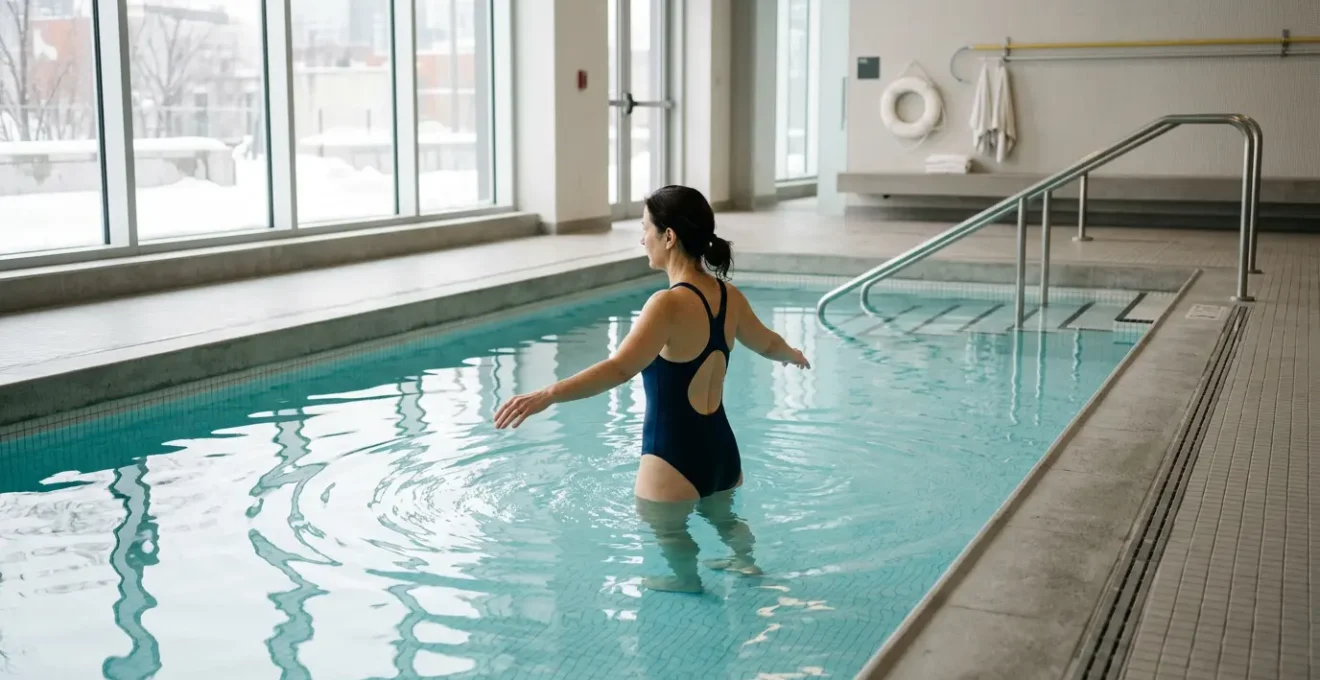
The key to regaining movement isn’t forcing through pain, but re-establishing a sense of safety within your own body to break the psychological fear-pain cycle.
- Kinesiophobia, or the fear of movement, can physically “freeze” your joints long after the initial injury has healed by keeping your nervous system in a state of high alert.
- Gentle, supported therapies like aquatic therapy and clinical Pilates are more effective than aggressive exercise in early recovery because they calm the nervous system first.
Recommendation: Start with the gentlest possible approach, like water therapy, to prove to your brain that movement can be safe and even pleasant again.
The echoes of a car accident often last longer than the bruises. For many survivors, the most significant barrier to recovery isn’t the initial injury, but the lingering memory of pain that creates a deep-seated fear of movement. You might find yourself in a frustrating loop: you want to move, to get back to your life, but every attempt is met with guarding, stiffness, and the haunting anticipation of pain. This isn’t a lack of willpower; it’s a protective mechanism of your nervous system that has become overactive. While standard advice often pushes for stretching and strengthening, this can be counterproductive when the root issue is psychological.
This guide is different. As a kinesiologist specializing in trauma recovery, I understand that true mobility is restored not by battling your body, but by working with it. We will explore how to gently coax your nervous system out of its protective state and re-establish a dialogue of trust with your muscles and joints. The solution isn’t to push through the pain, but to sidestep it with smarter, safer strategies. We’ll move beyond generic exercises and delve into specific, trauma-informed modalities that address the real source of your hesitation: the brain’s perception of threat. This is about re-teaching your body that movement can be a source of healing, not harm, with a path tailored to the unique resources available here in Montreal.
This article provides a structured roadmap for your recovery. We will explore the science behind why you feel “stuck,” and then detail the specific therapies and local resources that can help you move forward, safely and confidently.
Summary: A Trauma-Informed Path to Movement After an Accident
- Why Water Therapy Is Superior for First-Stage Trauma Mobility?
- The Psychological Trap That Freezes Your Joints After a Fall
- How Massage Therapy Breaks Down Scar Tissue That Restricts Movement?
- Yoga vs Pilates: Which Is Safer for Rebuilding Stability After Spinal Trauma?
- When Will You Be Able to Drive Again After a Major Leg Fracture?
- What Does Neurostimulation Actually Feel Like During a Session?
- Where to Find Specialized Trauma Support in Montreal Outside of Hospital Hours?
- How Functional Rehabilitation Differs from Standard Physiotherapy for Seniors?
Why Water Therapy Is Superior for First-Stage Trauma Mobility?
When the very thought of putting weight on a limb is daunting, land-based exercise can feel like an impossible task. This is where aquatic therapy, or hydrotherapy, becomes an invaluable first step. The unique properties of water create a ‘safe space’ for a traumatized body to rediscover movement. The buoyancy of water acts as a natural support system, significantly reducing the load on your joints and spine. When immersed, your body feels lighter, and movements that are painful on land can often be performed with ease and confidence in the pool. This provides immediate, positive feedback to your nervous system, beginning the crucial process of decoupling movement from the expectation of pain.
Furthermore, the therapeutic pools used for rehabilitation in Montreal are typically heated to a comfortable temperature (around 30-34°C). This warmth helps to relax tight, guarded muscles and increase blood flow, which can ease chronic pain and stiffness. It feels less like a workout and more like a gentle, supportive embrace. The water’s hydrostatic pressure also provides constant, gentle compression to your limbs, which can help reduce swelling and inflammation common after soft tissue injuries from an accident. As FisioMed’s local hydrotherapy program has shown, this environment is highly effective for whiplash, back pain, and other common MVA injuries, making it a comfortable and secure form of exercise during recovery.
For Montreal residents recovering from a car accident, accessing this therapy is straightforward. Your physician or physiotherapist can prescribe it, and it is often covered by the SAAQ (Société de l’assurance automobile du Québec) as part of an approved rehabilitation plan. Here are some resources to explore:
- Clinical rehabilitation pools: Specialized clinics like Physiothérapie Universelle offer prescribed aquatic therapy with trained professionals after an initial assessment.
- Community pools: Facilities such as the Aquadôme in LaSalle or the Centre Aquatique de Rivière-des-Prairies have pools with therapeutic temperatures and accessible programs suitable for self-managed care once you are cleared for it.
- Insurance coverage: Always confirm with your SAAQ adjuster, but prescribed aquatic physiotherapy is a recognized and frequently covered treatment. Many private extended health plans also cover these sessions.
The Psychological Trap That Freezes Your Joints After a Fall
If you feel physically capable but mentally blocked from moving, you are not alone. You are likely experiencing a common but poorly understood condition known as kinesiophobia. This is the central psychological trap that can stall recovery for months or even years.
Kinesiophobia is defined as an excessive irrational and debilitating fear of movement or physical activity.
– Physiopedia, Clinical definition of kinesiophobia
This is not just “being scared.” It is a learned response where your brain has created a powerful association between a specific movement and the intense pain of your accident. Now, even the *thought* of that movement triggers your body’s alarm system, causing muscles to tense up and “freeze” to prevent what it perceives as impending harm. It’s a vicious cycle: you fear movement because of pain, and this fear creates tension and stiffness that makes movement even more difficult and potentially painful, reinforcing the original fear. Studies on the subject are revealing; according to research compiled by Physiopedia, it’s estimated that up to 79% of subjects with musculoskeletal pain experience some degree of kinesiophobia.
Breaking this cycle requires a shift in approach. Instead of trying to “push through” the fear, a trauma-informed kinesiologist or physiotherapist will focus on proprioceptive re-education. This involves performing very small, slow, and gentle movements in a completely safe and supported range of motion. The goal is to send new, “safe” signals to your brain, proving that movement is possible without pain. It’s a gradual process of rebuilding trust between your mind and your body. The focus is on the quality and sensation of the movement, not on how far you can go. This process slowly rewires the neural pathways, diminishing the fear response and allowing for a greater range of motion over time.
How Massage Therapy Breaks Down Scar Tissue That Restricts Movement?
After an injury, the body’s natural healing process creates scar tissue. While essential for repair, this tissue is less flexible than normal muscle and fascia. When it forms in thick, disorganized patterns, it can create adhesions that “glue” layers of tissue together, severely restricting your range of motion. You might feel this as a deep, unyielding tightness that no amount of simple stretching seems to relieve. This is a physical manifestation of the trauma, but it is often reinforced by the psychological guarding we discussed.
Trauma-informed massage therapy goes beyond a standard relaxation massage. A therapist trained in post-accident recovery uses specific manual techniques, such as myofascial release and deep tissue work, to physically break down these adhesions. The goal is to realign the collagen fibers of the scar tissue, making them more pliable and functional. This process increases blood flow to the area, reduces nerve compression, and restores the ability of muscles to slide freely past one another. However, as research from Massage Magazine highlights, this work is most effective when the therapist understands the neurobiology of trauma. A body in a state of chronic hyper-activation from fear will resist release. The therapist must create a sense of safety to allow the stubbornly rigid musculature to finally let go.
Getting this crucial therapy covered in Quebec requires a systematic approach. Your therapist can’t simply state that you have scar tissue; they must document how it impacts your daily life. This focus on functional limitation is key for SAAQ approval.
Your Action Plan: Getting Scar Tissue Treatment Approved by the SAAQ
- Document Functional Limitations: Have your physiotherapist or ergothérapeute record specific, daily tasks that are restricted by scar tissue (e.g., “cannot reach overhead shelf,” “difficulty turning head to check blind spot”).
- Request a Physician Referral: Obtain a prescription from your doctor for “massage therapy” or “manual therapy” specifically for post-traumatic scar adhesions.
- Choose SAAQ-Certified Clinics: Select a facility, such as AMS Clinic, that is experienced and certified in handling SAAQ claims for accident recovery.
- Submit a Detailed Treatment Plan: Ensure your therapist submits a plan to the SAAQ that outlines the treatment goals in functional terms (e.g., “to restore enough shoulder mobility for independent dressing”).
- Track and Report Progress: Consistently document improvements in your range of motion and ability to perform tasks. This data justifies the need for continued coverage to your SAAQ adjuster.
Yoga vs Pilates: Which Is Safer for Rebuilding Stability After Spinal Trauma?
Once you’ve made progress with initial gentle movements, you may feel ready to engage in a more structured practice like yoga or Pilates. Both are excellent for body awareness, but when recovering from a significant trauma, especially involving the spine, the choice between them is critical. While traditional yoga focuses heavily on flexibility and achieving deep stretches, this can be risky in a post-trauma body where joint stability has been compromised. An untrained instructor or a generalized group class may inadvertently encourage movements that push you past a safe range, potentially re-injuring delicate tissues.
This is why Clinical Pilates is often the safer and more effective choice for post-accident rehabilitation. Unlike a gym class, Clinical Pilates is administered by a qualified physiotherapist. It begins with a thorough medical assessment of your specific injury. The exercises are then highly individualized to focus on rebuilding deep core stability and control *before* attempting large movements. Using equipment like the reformer, it provides support and resistance to guide your body through precise, controlled motions. This focus on stabilization is paramount after a spinal trauma, as it re-trains the small muscles that protect your spine during everyday activities.
The distinction becomes clear when you compare the approach and qualifications. A physiotherapist leading a Pilates session understands the biomechanics of your injury and knows which “red flag” movements to avoid, such as unsupported twists or deep forward flexion. This medical oversight is rarely present in a general yoga class. Furthermore, because it’s delivered as a component of physiotherapy, Clinical Pilates is often covered by the SAAQ or your extended health benefits, a significant advantage for long-term recovery.
The following table summarizes the key differences from a rehabilitation perspective:
| Aspect | Clinical Pilates | Traditional Yoga |
|---|---|---|
| Instructor Qualification | Led by physiotherapists with medical training | Varies widely, may lack trauma-specific training |
| Customization Level | Highly individualized based on injury assessment | Group classes with general modifications |
| Risk Assessment | Medical evaluation before starting | Self-reported limitations |
| Insurance Coverage | Often covered as physiotherapy | Rarely covered by accident insurance |
| Focus | Core stabilization and controlled movement | Flexibility and spiritual practice |
When Will You Be Able to Drive Again After a Major Leg Fracture?
Regaining the ability to drive is a significant milestone in reclaiming your independence after an accident. However, following a major leg fracture, this process is governed by strict safety and legal protocols in Quebec, not just by your personal feeling of readiness. The primary concern is your ability to react quickly and safely in an emergency. Your braking response time, strength, and coordination must be formally assessed before you can legally get back behind the wheel. Simply waiting for the bone to heal is not enough.
In Quebec, the process is managed carefully to ensure road safety for everyone. According to provincial regulations, a formal medical clearance is mandatory before you can resume driving after an injury that could affect your control of the vehicle. This isn’t just a doctor’s note; it often involves a comprehensive functional assessment. Attempting to drive without this clearance could not only be dangerous but could also invalidate your car insurance policy in the event of another incident.
The path to getting back on the road is a structured, multi-step process involving medical and rehabilitation professionals. The SAAQ has specific requirements and designated centres to perform these evaluations. Here is the typical process you will need to follow in Quebec:
- Step 1: Obtain Initial Physician Clearance. Once your orthopedic surgeon confirms your fracture has healed sufficiently to allow weight-bearing, you can begin the assessment process.
- Step 2: Complete the SAAQ-Mandated Functional Driving Assessment. This is conducted at specialized rehabilitation centres, such as those within the CIUSSS network.
- Step 3: Work with an Ergothérapeute. An Occupational Therapist (ergothérapeute) will perform a crucial in-car assessment to measure your reaction time, brake pedal force, and overall functional ability in a real or simulated driving environment.
- Step 4: Receive Recommendations. Based on the assessment, the ergothérapeute may recommend a period of further rehabilitation or, in some cases, specific vehicle modifications (e.g., a left-foot accelerator).
- Step 5: Notify Your Insurance Provider. Once you have received official clearance, you must inform your car insurance company before you start driving again to ensure your policy remains valid.
What Does Neurostimulation Actually Feel Like During a Session?
Neurostimulation, particularly Neuromuscular Electrical Stimulation (NMES), can sound intimidating, but the reality is a controlled and often comfortable therapeutic experience. It’s a tool used by physiotherapists to re-educate muscles that have “forgotten” how to contract properly due to pain, nerve injury, or prolonged disuse after an accident. The goal is not to cause pain, but to create a passive muscle contraction that you can see and feel, helping to re-establish the brain-to-muscle connection.
During a session, a therapist places self-adhesive electrode pads on your skin over the targeted muscle. The device is then turned on at a very low intensity. You’ll first feel a light, “pins and needles” or tingling sensation. This is the sensory stimulation. As the therapist gradually increases the intensity, you will start to see and feel your muscle twitch or gently contract on its own. The sensation is unusual but is typically not painful. It’s often described as a strong but non-painful “grabbing” or “pulling” feeling within the muscle. The therapist works with you to find a level that is strong enough to create a meaningful contraction but remains well within your comfort tolerance.
The technology itself is quite straightforward, designed for clinical precision and patient safety. As noted in clinical guidelines for its application:
NMES can be applied using battery-operated portable devices… devices with high power output (>80 mA) are required when using large electrodes.
– PMC Clinical Guidelines, Neuromuscular Electrical Stimulation for Treatment of Muscle Impairment
This means the therapist has precise control over the stimulation. The contraction is held for a few seconds, then released for a rest period, mimicking the natural rhythm of muscle work. The benefit is twofold: it helps maintain muscle mass and prevent atrophy while you are unable to exercise actively, and more importantly, it provides powerful biofeedback to your brain. By seeing and feeling the muscle work without having to voluntarily initiate it, you begin to rebuild the neural pathways necessary for active control, overcoming the inhibition caused by pain and trauma.
Where to Find Specialized Trauma Support in Montreal Outside of Hospital Hours?
Recovery from a car accident extends far beyond the 9-to-5 schedule of most clinics. Pain, anxiety, or a sudden crisis of confidence can strike at any time. Knowing where to turn for support outside of regular hospital or clinic hours is a critical part of a comprehensive safety plan for any trauma survivor in Montreal. The system can feel fragmented, but there are several reliable, 24/7 resources designed to help you navigate these difficult moments.
The first and most immediate line of support is Info-Santé 811. This free, confidential service is available 24/7 and connects you with a nurse or psychosocial worker who can provide advice, assess your situation, and direct you to the appropriate resource, all in English or French. For non-emergency physical concerns or mental health distress, this should be your first call. For ongoing support and to navigate the healthcare system during the day, your local CLSC (Centre local de services communautaires) is your community hub. They can help with follow-up services and connect you with longer-term programs.
In recent years, technology has also opened up new avenues for after-hours support. Some progressive clinics in Montreal now offer telerehabilitation services. As a case in point, SAAQ and CNESST certified providers like AMS Clinic allow existing patients to connect with a physiotherapist via secure video conference. This allows for guided exercise, consultation, and reassurance from the comfort of your home, provided you meet the safety criteria. This can be a lifeline when you experience a setback on a weekend or evening and need professional guidance.
Here is a list of key resources to keep on hand for after-hours support in Montreal:
- Info-Santé 811: Your primary 24/7 contact for nursing and psychosocial advice.
- Local CLSC: Your daytime hub for navigating services and getting follow-up care.
- Crisis Lines: For acute mental health emergencies, contact specialized services like Tracom or Suicide Action Montréal.
- Telerehabilitation: Ask your physiotherapy clinic if they offer remote consultation services for established patients, a service that is increasingly available.
- Private Emergency Clinics: Some private clinics may offer extended hours for urgent but non-life-threatening rehabilitation needs.
Key Takeaways
- True recovery begins by calming the nervous system, not by fighting through pain. Fear of movement (kinesiophobia) is a real physiological barrier.
- Gentle, supportive environments like aquatic therapy are superior starting points as they provide positive feedback to the brain that movement can be safe.
- The ultimate goal is “functional rehabilitation”—training for real-life Montreal activities like navigating icy sidewalks or using the Metro, not just abstract gym metrics.
How Functional Rehabilitation Differs from Standard Physiotherapy for Seniors?
As we get older, recovering from a major trauma like a car accident presents unique challenges. While standard physiotherapy plays a crucial role, its goals can sometimes be abstract. It might focus on achieving a certain number of degrees in knee flexion or lifting a specific weight. Functional rehabilitation, especially for seniors, takes a different, more meaningful approach. It asks a more important question: “What do you need to be able to do to live your life fully and independently in your own environment?”
The focus shifts from isolated muscle metrics to whole-body tasks that are relevant to your daily life in Montreal. Instead of just strengthening your quads, a functional program trains you for the specific challenge of getting in and out of an STM bus or navigating the stairs at a Metro station. Instead of just practicing balance on a stable surface, you might work on exercises that simulate walking on uneven or icy Montreal sidewalks. This approach is inherently more motivating because the goals are tangible and directly tied to your independence. The success of this approach hinges on the expertise of an *ergothérapeute* (Occupational Therapist), who specializes in analyzing daily tasks and creating programs to restore that capacity.
This personalized approach is highly valued by the SAAQ, as it directly correlates to a person’s ability to return to their life pre-accident. As Quebec rehabilitation guidelines emphasize:
Functional capacity evaluations performed by ergothérapeutes are critical reports used by the SAAQ.
– Quebec Rehabilitation Guidelines, SAAQ Assessment Requirements
This means that a program designed around functional goals is not only more practical but also more likely to be supported by your insurance. The table below illustrates the difference in mindset between the two approaches for a senior recovering from an MVA:
| Approach | Standard Physiotherapy Goal | Functional Rehabilitation Goal |
|---|---|---|
| Knee Recovery | Achieve 110 degrees of knee flexion | Be able to get in and out of an STM bus or Metro without assistance |
| Shoulder Mobility | Restore 180 degrees shoulder flexion | Reach overhead storage in your Montreal apartment |
| Walking Ability | Walk 100 meters without stopping | Navigate icy Montreal sidewalks safely in winter |
| Balance Training | Stand on one leg for 30 seconds | Safely use escalators at Metro stations |
Ultimately, your journey back to mobility is a partnership between your mind and body. By choosing therapies that build safety, address fear, and focus on real-life goals, you are not just healing an injury—you are reclaiming your life. To put these principles into practice, the next logical step is to have a personalized assessment with a professional who understands this trauma-informed approach.
Frequently Asked Questions on a Trauma-Informed Return to Movement
What is your experience with post-MVA clients?
When choosing an instructor or therapist, look for professionals who have specific experience working with car accident survivors. They will better understand the unique challenges of trauma recovery, including the pervasive fear of movement and common injury patterns like whiplash and spinal issues.
How do you modify for spinal fusions or disc injuries?
A qualified instructor should be able to provide immediate and specific alternatives for potentially risky movements. For spinal injuries, this includes modifying or avoiding deep unsupported twists, end-range forward folds, and sudden backbends, often using props and supported positions to ensure safety.
What red flag movements should I avoid?
In the early stages of recovery from a spinal injury, it’s wise to avoid any movement that creates sharp pain or a feeling of instability. Specifically, deep unsupported twists, any movement that pushes you to the absolute end of your flexibility range (end-range flexion), and any sudden, ballistic movements should be carefully modified or avoided until your core stability is fully restored.