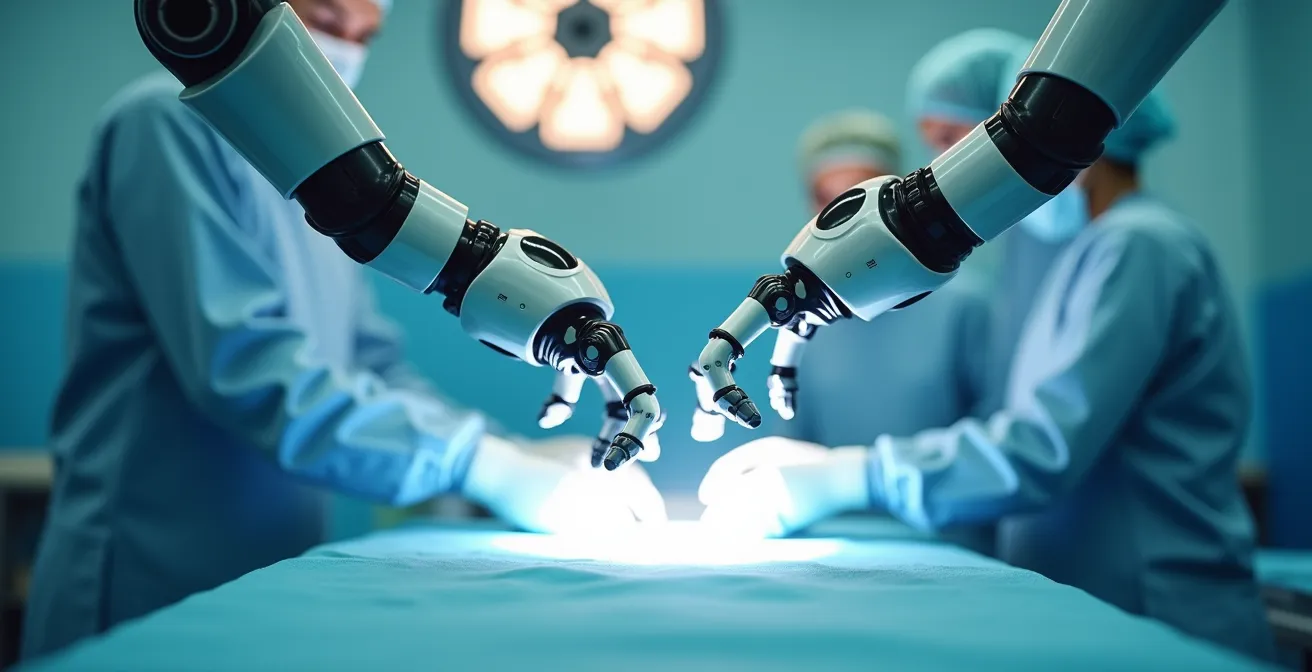
The significantly faster recovery from robotic hysterectomy stems from a continuum of care that minimizes the body’s systemic stress before, during, and after the procedure.
- Superior surgical precision and smaller incisions drastically reduce tissue trauma, inflammation, and blood loss.
- Pre-operative conditioning (« pre-hab ») builds a functional reserve, allowing your body to better withstand the stress of surgery.
Recommendation: Discussing a pre-habilitation plan with your surgeon can be as crucial as the surgery itself for accelerating your return to daily life.
For any woman facing a hysterectomy, the primary concern often extends beyond the surgery itself to the recovery period. The prospect of weeks away from work, family, and daily routines can be daunting. Traditional open surgery, with its large incision and significant tissue disruption, historically meant a recovery of six to eight weeks. While standard laparoscopy improved this, a new surgical paradigm is fundamentally changing the equation. The question is no longer just about a « less invasive » procedure, but about understanding *why* robotic-assisted surgery can shorten recovery by two weeks or more.
The common understanding is that smaller incisions are the main benefit. While true, this only scratches the surface. The real advantage lies in a sophisticated interplay between advanced technology and proactive patient preparation. It’s about reducing the overall « surgical footprint » on the body. This approach minimizes the systemic stress from start to finish, from pre-operative conditioning that builds resilience to post-operative pain management that requires fewer narcotics. This holistic view is the key to unlocking a dramatically faster return to normalcy.
This article will deconstruct the mechanisms behind this accelerated recovery. We will explore how the precision of robotics not only protects surrounding tissues but also enables procedures that were previously more complex. We will delve into the science of « pre-hab » and its proven impact on hospital stays, and examine how these combined factors create a recovery experience that is fundamentally different—and faster.
This comprehensive guide breaks down the key technological and physiological advantages that contribute to a quicker, smoother recovery. Follow along to understand the complete picture of modern gynecological surgery.
Summary: Understanding Accelerated Recovery with Robotic Surgery
- Single-Port Surgery: Can You Really Have Surgery With No Visible Scar?
- How Robotic Myomectomy Preserves the Uterus Better Than Open Surgery?
- Why Is Robotic Surgery Safer for Patients With High BMI?
- The Risk of Thermal Injury During Electrosurgery You Didn’t Know About
- Diet and Exercise: How to Prepare Your Body for Robot-Assisted Surgery?
- Why Is Pain Medication Use Lower After Robotic Surgery?
- Why Does « Pre-Hab » Exercise Reduce Your Hospital Stay by 2 Days?
- AI in Dermatology: Is an App as Accurate as a Real Doctor for Mole Checking?
Single-Port Surgery: Can You Really Have Surgery With No Visible Scar?
The aesthetic benefit of minimally invasive surgery is often a significant factor for patients. Single-port robotic surgery takes this concept to its ultimate conclusion: a procedure performed through a single, small incision hidden within the navel. Once healed, the scar is virtually undetectable, blending into the natural contours of the umbilicus. This answers a profound desire for not just physical healing, but the preservation of bodily integrity, leaving no visible reminder of the surgery.

But the advantage is more than cosmetic. A single entry point means less disruption to the abdominal wall muscles and fascia. This translates directly to less postoperative pain, a lower risk of incision-related hernias, and a quicker return to core-dependent activities. The procedure itself is a marvel of engineering, and studies are validating its efficiency. For example, recent 2024 data shows single-port robotic hysterectomies can be performed with a median operative time of 209 minutes and minimal blood loss of just 100 mL. This level of efficiency, combined with minimal scarring, represents a major leap in patient-centered care. In Canada, specialized centers are leading the way in this technology. For instance, Toronto General Hospital and Mount Sinai Hospital are among the few in the Toronto area with robotic platforms, where expert surgeons have performed hundreds of these complex cases, making this advanced care accessible to patients in major hubs like Montreal and the surrounding regions.
This approach transforms the surgical experience, shifting the focus from enduring a procedure to actively participating in a swift and discreet healing process.
How Robotic Myomectomy Preserves the Uterus Better Than Open Surgery?
For women with uterine fibroids who wish to preserve their fertility, a myomectomy (the surgical removal of fibroids) is the standard of care. The challenge has always been to remove the fibroids completely while meticulously reconstructing the uterus to ensure it can safely carry a future pregnancy. This is where robotic surgery offers a distinct advantage over traditional open surgery. The robot’s instruments provide seven degrees of freedom, mimicking the human wrist but with enhanced precision and tremor filtration. This allows the surgeon to make extremely precise incisions into the uterine wall and, most importantly, to suture the layers back together with exceptional accuracy.
This meticulous, multi-layered closure is critical for the integrity of the uterine wall, reducing the risk of a weak scar that could rupture during a future pregnancy. The improved visualization in 3D high-definition also allows the surgeon to identify and remove even small fibroids that might be missed in an open procedure, potentially reducing the chance of recurrence. The clinical outcomes support this approach. For instance, Canadian research demonstrates a 70% pregnancy rate after robotic myomectomy, offering significant hope to women planning a family. While the procedure greatly enhances uterine integrity, it is crucial to acknowledge all potential outcomes.
The rate of uterine rupture after robot-assisted myomectomy has been reported to be between 0.6% to 10%.
– Clinical study authors, Obstetrics & Gynecology Science
This statistic underscores the importance of choosing a highly experienced surgeon and highlights that while robotics significantly improves uterine reconstruction, the risk, though often low, is not zero. It’s a balanced consideration of immense benefit against a small, manageable risk.
Ultimately, the precision of robotic myomectomy provides a superior foundation for future fertility by creating the strongest possible uterine repair.
Why Is Robotic Surgery Safer for Patients With High BMI?
Performing surgery on patients with a high Body Mass Index (BMI) presents unique challenges, particularly in open and even standard laparoscopic procedures. Increased adipose tissue can limit a surgeon’s visibility and maneuverability, potentially leading to longer operative times and greater blood loss. Robotic surgery directly mitigates these challenges, creating a safer surgical environment for this patient population. A key factor is the positioning required for gynecological surgery, known as the Trendelenburg position (head-down tilt), which can compromise respiratory function, especially in patients with a high BMI. The robotic system offers a significant advantage here.

Research from the University of Toronto confirms that for patients with a BMI > 40, robotic surgery allows for improved ventilation because the procedure can be performed at a lower intra-abdominal pressure. The robotic arms physically lift the abdominal wall, creating the necessary space without requiring high-pressure gas that can impede lung function. This mechanical advantage is one of several that enhance safety:
- Superior Visualization: The robotic platform’s third arm can hold a retractor, lifting away heavy tissue and providing the surgeon with a clear, stable view of the surgical field that is difficult to achieve manually.
- Instrument Stability: The robotic instruments are fixed in place, eliminating the fulcrum effect seen in laparoscopy where the abdominal wall is used as a pivot, which can be more difficult with thicker abdominal walls.
- Ergonomic Benefits: The surgeon operates from a console, eliminating the physical strain of long procedures, which can be more pronounced in complex cases involving patients with high BMI. This reduces surgeon fatigue and helps maintain peak performance.
By transforming the surgical environment, robotics effectively levels the playing field, offering patients with high BMI access to the benefits of minimally invasive surgery with a risk profile comparable to patients with a lower BMI.
The Risk of Thermal Injury During Electrosurgery You Didn’t Know About
One of the unspoken risks in any minimally invasive surgery is thermal injury. Surgeons use electrosurgical instruments to cut tissue and coagulate blood vessels, but this energy can sometimes unintentionally spread to and burn adjacent organs like the bowel or bladder. This can happen through direct contact or a phenomenon called « capacitive coupling, » where energy arcs from the instrument to nearby tissue. The consequences can be severe, leading to post-operative complications that are difficult to diagnose. Robotic surgical systems are engineered with multiple features to minimize this specific risk, enhancing patient safety beyond just the precision of movement.
The system’s core design provides a fundamental layer of protection. The robot’s instruments mimic human hand movements but with the absolute steadiness of robotic arms. This stability makes it easier to operate on organs for extended periods and from difficult angles without accidental slips or contact with non-target tissues. This control is paramount when working in close proximity to vital structures. Furthermore, modern robotic platforms are moving towards « smart » instruments that provide an additional layer of safety.
These advanced instruments often incorporate feedback loops that modulate energy delivery. They can sense tissue resistance and automatically adjust or stop the energy flow before overheating occurs, a feature that acts as a crucial safeguard against burns. The very design of the instruments also helps mitigate risks like capacitive coupling. Through specialized insulation and engineering, the potential for stray electrical currents to escape and damage nearby tissue is significantly reduced. This built-in technological vigilance provides the surgeon with greater confidence to use energy devices effectively while protecting the patient from unintended harm.
By addressing the hidden danger of thermal spread, robotic surgery adds a critical, often overlooked, layer of safety that contributes to a smoother, complication-free recovery.
Diet and Exercise: How to Prepare Your Body for Robot-Assisted Surgery?
The concept of « pre-habilitation » or « pre-hab » is a cornerstone of modern surgical care, particularly within Enhanced Recovery After Surgery (ERAS) protocols. The idea is simple yet powerful: preparing your body for the physiological stress of surgery can significantly accelerate your recovery afterward. Think of it as training for a marathon; you wouldn’t just show up on race day without preparation. Surgery, even a minimally invasive one, is a major event for your body. By improving your physical condition beforehand, you build a « functional reserve » that helps you bounce back faster.
This preparation involves a multi-faceted approach focusing on nutrition, targeted exercise, and respiratory health. A diet rich in protein is essential, as protein is the building block for tissue repair. Core strengthening exercises are particularly important for abdominal surgeries like a hysterectomy, as a strong core provides better support to the surgical area post-op. Finally, improving lung capacity through deep breathing exercises helps prevent common post-operative respiratory complications. As a leading medical institution advises, this proactive approach has quantifiable benefits.
Pre-habilitation exercise reduces hospital stay by 2 days
– Research team, Enhanced Recovery After Surgery protocols
This isn’t just about feeling better; it’s about creating measurable improvements in clinical outcomes. A well-prepared patient is better equipped to handle anesthesia, experiences less muscle atrophy during the immediate recovery phase, and is able to mobilize sooner.
Action Plan: Your Pre-Surgery Preparation Checklist
- Nutrition Focus: Increase protein intake to support tissue repair (aim for 1.2-1.5 grams per kilogram of your body weight daily) and prioritize anti-inflammatory foods like omega-3 rich fish.
- Core Strengthening: Perform daily core exercises like planks and pelvic tilts for at least two to four weeks before your scheduled surgery date to build abdominal support.
- Respiratory Health: Practice deep breathing and incentive spirometry exercises daily to maximize lung capacity and reduce the risk of post-operative pneumonia.
- Cardiovascular Fitness: Engage in 30 minutes of light cardiovascular activity, such as brisk walking, each day to improve overall circulation and stamina.
- Final Consultation: Review your pre-hab plan with your surgeon to ensure it is tailored to your specific health needs and the planned procedure.
By taking these proactive steps, you shift from being a passive recipient of care to an active partner in your own accelerated recovery.
Why Is Pain Medication Use Lower After Robotic Surgery?
A significant driver of a faster, more comfortable recovery is the reduced need for postoperative pain medication, particularly opioids. The answer lies directly in the reduced « surgical footprint. » Pain is the body’s response to tissue trauma. Because robotic surgery involves much smaller incisions and significantly less pulling and tearing of internal tissues compared to open surgery, the initial inflammatory response and resulting pain signals are dramatically lessened. The precise, tremor-free movements of the robotic arms mean that the dissection of tissue is clean, causing minimal collateral damage.

This reduction in tissue trauma has a direct, measurable impact on the need for powerful analgesics. Patients report lower pain scores from the moment they leave the recovery room, allowing them to rely more on non-opioid medications like anti-inflammatories. This is not just a « nice-to-have » benefit; it’s a critical component of accelerated recovery. Less opioid use means fewer side effects like drowsiness, constipation, and nausea, which can hinder early mobilization. Getting up and walking sooner is key to preventing blood clots and stimulating bowel function. Clinical data confirms this trend across various procedures. For instance, a 2024 study found a 40-60% reduction in morphine equivalents used post-robotically compared to standard laparoscopy. This is a substantial decrease that directly impacts patient comfort and alertness.
By minimizing the root cause of surgical pain—tissue trauma—robotic surgery creates a positive feedback loop. Less pain leads to less need for opioids, which leads to fewer side effects, enabling quicker mobilization and a faster return of normal bodily functions. This entire cascade begins with the precision of the surgeon’s hands, amplified by the robot.
This shift in pain management transforms the postoperative experience from one of endurance to one of active, comfortable healing.
Why Does « Pre-Hab » Exercise Reduce Your Hospital Stay by 2 Days?
The idea that exercise *before* surgery can shorten your time *in* the hospital afterward seems counterintuitive, but it’s backed by robust science. The key is building « functional reserve. » Surgery and anesthesia place immense stress on the body, particularly the cardiovascular and respiratory systems. Pre-hab acts like a training camp, strengthening these systems so they have a larger buffer to handle that stress. When a patient with a higher functional reserve undergoes surgery, their body is better able to maintain normal function, even under duress. This resilience is a primary reason for earlier discharge.
Studies consistently show that the implementation of Enhanced Recovery After Surgery (ERAS) protocols, with pre-hab as a core component, results in a 2-3 day shorter hospital stay on average. A major factor contributing to this is the reduction of postoperative pulmonary complications (PPCs), such as pneumonia. Anesthesia and immobility after surgery can lead to collapsed air sacs in the lungs, creating a breeding ground for infection. Pre-hab exercises, especially those using an incentive spirometer, expand the lungs and strengthen respiratory muscles, making patients far less susceptible to these complications, which are a leading cause of extended hospital stays.
Case Study: The Impact of Pre-habilitation on Post-Operative Complications
A review of surgical outcomes revealed a clear pattern: patients who engaged in a pre-habilitation program that included targeted respiratory exercises showed a significantly lower incidence of post-operative pneumonia. The functional reserve built through these exercises allowed their bodies to better withstand the physiological stress of surgery and anesthesia. This resilience meant they could mobilize earlier, clear their lungs more effectively, and were less likely to develop infections that would otherwise prolong their hospitalization, demonstrating a direct link between pre-operative effort and post-operative success.
Furthermore, a fitter patient is able to get out of bed and walk sooner after surgery. This early mobilization is critical. It stimulates circulation to prevent blood clots, encourages the return of bowel function, and prevents the muscle deconditioning that occurs with prolonged bed rest. A patient who is up and moving on day one is on a clear path to being discharged on day two or three.
Pre-hab empowers the patient, turning a period of anxious waiting into a productive phase of preparation that pays concrete dividends in the hospital.
Key Takeaways
- Robotic surgery’s main advantage is not just small scars, but a drastic reduction in systemic stress on the body.
- The combination of surgical precision and pre-operative patient conditioning (« pre-hab ») is what enables a recovery that is weeks faster.
- Benefits are quantifiable: less blood loss, lower need for opioids, and a hospital stay shortened by an average of two days.
AI in Dermatology: Is an App as Accurate as a Real Doctor for Mole Checking?
As technology permeates every aspect of healthcare, it’s natural for patients to seek out tools that promise convenience and early detection, such as AI-powered apps for mole checking. These applications use algorithms trained on thousands of images to assess the risk of a skin lesion being malignant. While the technology is impressive and constantly improving, it’s crucial for patients, especially here in Montreal and across Canada, to understand its proper role. AI is a powerful assistant, not a replacement for a trained dermatologist. As the Health Canada Advisory Board emphasizes, these tools have a place, but with clear limitations.
AI assists dermatologists in triaging cases but should never replace professional consultation
– Health Canada Advisory Board, Canadian Dermatology Association Guidelines
The primary value of these apps is in raising awareness and encouraging people to monitor their skin. However, they can produce both false positives, causing unnecessary anxiety, and false negatives, creating a dangerous sense of security. A dermatologist’s diagnosis is based not only on what a mole looks like but also on the patient’s history, risk factors, and the feel of the lesion (palpation)—data an app cannot access. Therefore, it is essential to follow the proper clinical pathway for any skin concerns.
For residents in Montreal, the process should be clear and systematic. These technologies are best used as personal monitoring aids, not diagnostic tools. Here is the recommended approach:
- Use AI apps to track changes in moles over time, but do not rely on their assessment for a diagnosis.
- Always begin with your family doctor (GP) for an initial evaluation of any concerning lesion.
- If there is a concern, your GP will provide a referral to a dermatologist covered by the provincial health plan (RAMQ).
- Adhere to the screening schedule recommended by the specialist, based on your individual risk factors.
- Document any changes you notice between appointments to provide valuable information to your doctor.
Ultimately, technology is at its best when it enhances, not replaces, the crucial relationship and expert judgment of a qualified physician. To ensure your health is in the best hands, discussing these advanced options with a specialist is the essential next step.