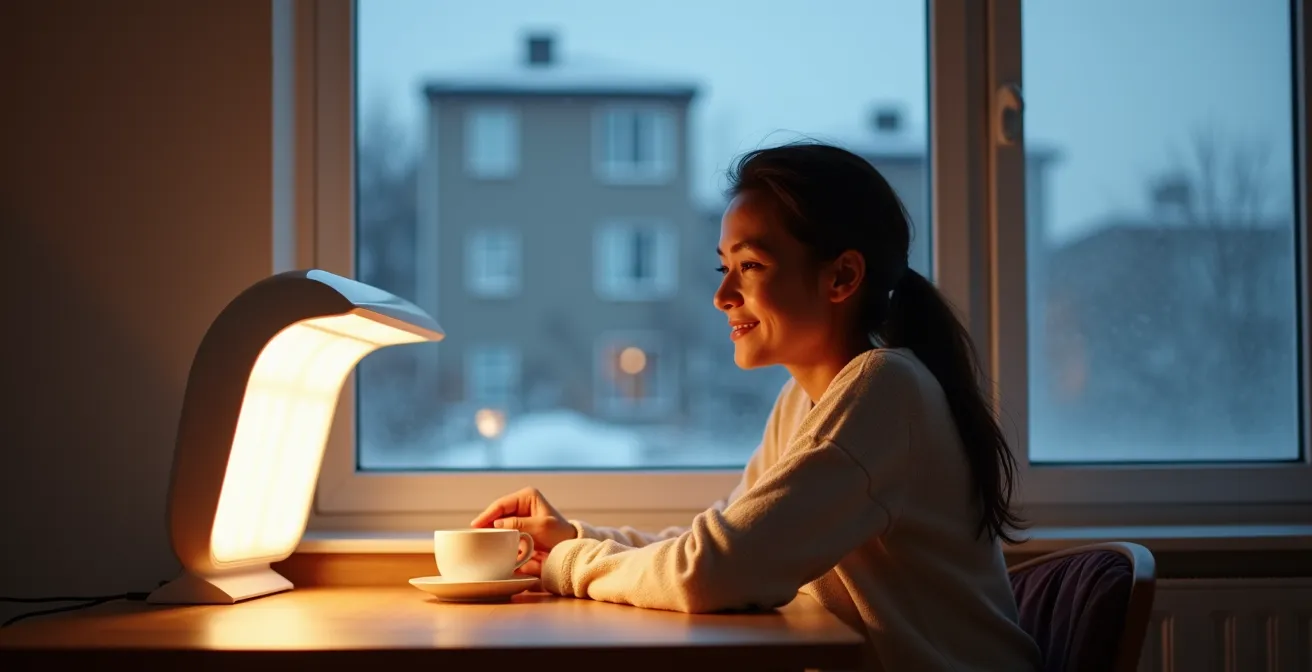
A 10,000 lux lamp is not a placebo; it’s a medical tool that works by recalibrating your brain’s internal clock, but only if used with clinical precision.
- Effectiveness depends on a non-negotiable dose of 10,000 lux, as anything less fails to trigger the necessary biological response.
- Timing is critical: morning exposure is proven to be over twice as effective as evening use for resetting your circadian rhythm.
Recommendation: Treat light therapy like a prescription. Pair a certified 10,000 lux lamp with a consistent morning routine and discuss vitamin D supplementation with your Quebec-based doctor to truly combat Seasonal Affective Disorder.
Every year, as the days shorten and the sun sets over Montreal before the workday is even done, a familiar lethargy descends. For many Quebecers, this is more than just « winter blues »; it’s a predictable pattern of low energy, carbohydrate cravings, and a desire to hibernate known as Seasonal Affective Disorder (SAD). In response, light therapy lamps have flooded the market, from shelves at Pharmaprix to online ads, all promising a dose of artificial sunshine. The central question for anyone feeling the weight of our long winter is a clinical one: is this a genuine therapeutic intervention or simply an expensive placebo?
From a psychiatric standpoint, the answer is nuanced. The conventional advice to « buy a bright lamp » is dangerously simplistic. It overlooks the rigorous science that underpins effective phototherapy. The effectiveness of a light therapy lamp is not a matter of opinion but of biophysics. It hinges on a precise « dosage » of light intensity (lux), specific timing, and filtering of harmful UV rays. Without these parameters, you are indeed just staring at a bright light with little hope of a clinical outcome. Many so-called « SAD lamps » sold online fail to meet these critical medical standards.
This article moves beyond the marketing claims to provide an evidence-based framework for a Quebecer considering light therapy. We will dissect the non-negotiable scientific requirements that separate a clinically effective device from a useless gadget. We will explore how to use this tool as part of a holistic strategy that includes diet, behavioral changes, and other supports available right here in Quebec, all to systematically reset the biological clock that winter has thrown off course. This is not about finding a magic cure, but about understanding and correctly applying a proven medical treatment.
To navigate this topic, we will break down the essential components of an effective SAD management strategy, from the hard science of light intensity to the practical realities of protecting your skin against the Montreal cold. This guide provides a clear path to making an informed decision.
Summary: A Clinical Approach to Beating the Montreal Winter Blues
- Why Must Your Lamp Be 10,000 Lux to Actually Reset Your Brain?
- How to Eat to Boost Serotonin When the Sun Goes Down at 4 PM?
- Seasonal Blues vs Major Depression: Which One Requires Medication?
- The « Hibernation » Trap That Worsens Depression in Winter
- When to Use Your Light Lamp: Morning or Evening?
- How to Calculate Your Ideal Vitamin D Dosage Based on Body Weight?
- Why Does Blue Light Exposure After 9 PM Destroy Your Deep Sleep?
- How to Protect Your Skin Barrier Against -20°C Windchill in Montreal?
Why Must Your Lamp Be 10,000 Lux to Actually Reset Your Brain?
The 10,000 lux specification is not an arbitrary marketing number; it’s the minimum therapeutic dose required to trigger a specific neurological process. Your brain’s master clock, the suprachiasmatic nucleus (SCN), regulates your circadian rhythm—your sleep-wake cycle, hormone release, and energy levels. In winter, the delayed and weak sunrise in Montreal fails to provide a strong enough signal to reset this clock properly. The result is a phase-delayed rhythm, making you feel groggy in the morning and tired all day. A 10,000 lux lamp, used for about 30 minutes, mimics the intensity of the morning sun and provides the powerful signal your SCN needs to suppress melatonin production and synchronize your internal clock with the outside world.
To put this in perspective, standard indoor lighting provides only about 500 lux. Even a dreary, overcast November day in Montreal might only offer 10,000 lux for a brief period, which is insufficient. The clinical evidence is clear: lower-intensity lamps simply do not provide enough photonic energy to induce the required biological shift. Research from 14 centers studying 332 patients found a 53% remission rate with morning light therapy using a 10,000 lux equivalent, compared to just 11% with a dim light placebo. This demonstrates that intensity is a primary factor in treatment success. Using a weaker lamp is akin to taking a fraction of a prescribed medication dose—the effect will be negligible, if any.
Your Checklist: Buying a Medically-Recognized Lamp in Quebec
- Verify CSA certification, a requirement for medical devices sold in Canada.
- Shop at a recognized pharmacy like Shoppers Drug Mart/Pharmaprix for medically-approved devices.
- Consider contacting a local specialist like Northern Light Technologies in St. Laurent, Quebec (1-514-335-1763) for expert advice.
- Confirm the specifications state 10,000 lux output and full UV filtering to protect your eyes and skin.
- Inquire with your insurance provider about potential coverage under your medical equipment benefits.
How to Eat to Boost Serotonin When the Sun Goes Down at 4 PM?
When darkness falls early in Montreal, it’s common to experience intense cravings for carbohydrates. This isn’t a lack of willpower; it’s a biological drive. Carbs can temporarily increase levels of tryptophan, a precursor to the mood-regulating neurotransmitter serotonin. However, relying on simple carbs like pasta and sweets leads to a crash, worsening fatigue and weight gain. A more sustainable strategy is to provide your brain with the building blocks for serotonin production through a targeted diet, focusing on whole foods readily available in Quebec winters.
Instead of the carb-crash cycle, focus on a diet rich in omega-3 fatty acids, lean protein, and complex carbohydrates. Research from the Cleveland Clinic highlights that SAD patients often increase carb intake, leading to lower energy. Healthcare providers recommend focusing on vitamin D-enriched foods to combat symptoms naturally. For a Montrealer, this means prioritizing items from local markets like Marché Jean-Talon or your neighbourhood IGA and Metro.
Your winter grocery list should include:
- Omega-3 Rich Fish: Arctic char and Atlantic salmon are excellent sources and widely available. Omega-3s are crucial for brain health and mood regulation.
- Quebec-Made Aged Cheeses: Many local cheeses are high in tryptophan, the essential amino acid that your body converts into serotonin.
- Root Vegetables: Local parsnips, turnips, and beets from stores like Provigo provide complex carbohydrates for sustained energy without the crash.
- Lentils and Legumes: These are an affordable source of protein and mood-stabilizing B vitamins.
- Dark Leafy Greens: Greenhouse-grown kale and spinach are available year-round and packed with essential nutrients.
Seasonal Blues vs Major Depression: Which One Requires Medication?
It is clinically essential to differentiate between Seasonal Affective Disorder (SAD) and Major Depressive Disorder (MDD). While both involve a depressed mood, they are distinct conditions with different treatment pathways. SAD is, by definition, a recurring depression with a seasonal pattern—symptoms begin in the fall/winter and remit in the spring. MDD can occur at any time of year and may not have this predictable cycle. A key differentiator lies in the specific « atypical » symptoms of SAD. As a psychiatrist, I look for a distinct clinical profile to make a diagnosis.
This visual guide symbolizes the journey of finding the right support within the Quebec healthcare system, where each point of light represents a step towards wellness.

As the image suggests, finding the right path starts with identifying the problem. Dr. Eric Alcera, a psychiatrist at Hackensack Meridian Health, provides a clear distinction:
SAD tends to be more of a lethargic depression, whereas MDD is more of an irritable depression. The difference is that SAD patients tend to oversleep and overeat, whereas MDD patients tend to have insomnia and have a loss of appetite.
– Dr. Eric Alcera, Hackensack Meridian Health
Light therapy is a frontline treatment for SAD. However, if symptoms are severe, include thoughts of self-harm, or do not respond to light therapy and lifestyle changes, it is crucial to consult a doctor. Antidepressant medication, particularly SSRIs which target serotonin, may be necessary for both severe SAD and MDD. In Quebec, your family doctor or a CLSC can be your first point of contact for a proper evaluation.
The « Hibernation » Trap That Worsens Depression in Winter
The instinct to withdraw and conserve energy during the dark, cold months is a powerful one. This « hibernation » response—social withdrawal, decreased activity, and oversleeping—is a core feature of SAD. While it may feel natural, it creates a vicious cycle. Less exposure to natural light, however weak, further dysregulates your circadian rhythm. Less social interaction removes a key source of mood support, and reduced physical activity lowers the production of mood-boosting endorphins. From a clinical perspective, this behavioural pattern is one of the biggest obstacles to recovery. Actively fighting this urge is a form of treatment in itself, known as behavioral activation.
In regions like ours, where Montreal and the Northeast experience 39 fewer sunny days per year than the national average, passively waiting for motivation to strike is a losing strategy. As psychologist Dr. Kia-Rai Prewitt notes, « Sometimes it takes forcing yourself to do something enjoyable even when you don’t feel like it. » The key is to schedule activities and commit to them, regardless of your mood. Fortunately, Montreal offers a wealth of opportunities to break the hibernation cycle:
- Get outside: Take advantage of the free skating rink at Parc La Fontaine or walk through the illuminated art of Luminothérapie in the Old Port.
- Seek warmth and green: Visit the Biodome’s tropical ecosystem for a dose of warmth, humidity, and vibrant plant life.
- Embrace the cold: Dress warmly and attend an outdoor event like Igloofest. The combination of music, social connection, and fresh air can be powerfully uplifting.
- Use the city’s infrastructure: Explore Montreal’s 33km underground RESO network to walk for kilometres in a heated, bright environment.
- Engage your mind: Join one of the free community art workshops at the Montreal Museum of Fine Arts to connect with others and engage in a creative activity.
When to Use Your Light Lamp: Morning or Evening?
The timing of light exposure is as critical as the intensity. Using a 10,000 lux lamp at the wrong time can be ineffective or even counterproductive. The goal of light therapy for SAD is to correct a « phase-delayed » circadian rhythm—your internal clock is running late. To fix this, you need to provide a strong « advance » signal, which is most effectively done first thing in the morning. Morning light exposure tells your brain to suppress melatonin (the sleep hormone) and start the day’s internal clock on time.
Conversely, using a bright light in the evening can be detrimental. It sends a confusing signal to your brain, essentially telling it that it’s still daytime. This can further delay your circadian rhythm, making it even harder to fall asleep and wake up, exacerbating the very problem you’re trying to solve. The clinical data overwhelmingly supports this. Clinical studies show a 62% remission with morning light compared to only 28% with evening light. This more than twofold difference underscores that morning use is a non-negotiable part of an effective protocol.
This table outlines a practical morning routine for a Montrealer in deep winter, integrating light therapy for maximum effect, as recommended by institutions like the Ohio State University Wexner Medical Center.
| Time | Activity | Light Exposure |
|---|---|---|
| 6:30 AM | Wake with sunrise alarm | Gradual dawn simulation |
| 7:00-7:30 AM | Light therapy + breakfast | 10,000 lux for 30 minutes |
| 7:30 AM | December sunrise in Montreal | Natural light supplement |
| 8:00 PM onwards | Avoid bright screens | Blue light filtering essential |
How to Calculate Your Ideal Vitamin D Dosage Based on Body Weight?
Vitamin D, the « sunshine vitamin, » is a crucial pro-hormone for mood regulation. In Quebec, its deficiency is nearly universal during winter. The low angle of the sun from October to April means the UVB rays required for your skin to synthesize vitamin D do not sufficiently penetrate the atmosphere. No amount of time spent outside in the January cold will allow your body to produce adequate vitamin D. Therefore, for most Quebecers, supplementation is not optional, it is essential for both physical and mental health. While light therapy addresses the circadian aspect of SAD, vitamin D deficiency addresses a key biochemical component.
This illustration visualizes the problem: the winter sun in Montreal is too low on the horizon for its rays to effectively trigger Vitamin D synthesis in the skin.

Calculating a precise dose based on body weight alone is not the recommended clinical approach without a blood test. The only way to know your ideal dosage is to get your levels tested. Here is the practical pathway in Quebec:
- Request a blood test: Ask your family doctor for a « 25-hydroxy vitamin D » blood test. When medically justified by symptoms of SAD or fatigue, this test is covered by RAMQ.
- Purchase quality supplements: Look for products with a Natural Product Number (NPN) at pharmacies like Jean Coutu or Pharmaprix. This ensures they meet Health Canada’s standards.
- Consult a pharmacist: Discuss your blood test results with a pharmacist to choose the right dosage form (drops, pills) and strength.
- Follow guidelines: Health Canada provides baseline recommendations, but your doctor will advise a personalized therapeutic dose based on your deficiency level. Self-prescribing high doses can be toxic, so medical supervision is paramount.
Why Does Blue Light Exposure After 9 PM Destroy Your Deep Sleep?
Managing your light environment is a 24-hour job. The gains made with a 30-minute morning light therapy session can be completely undone by improper light exposure in the evening. The same photoreceptors in your eyes that react to your SAD lamp are exquisitely sensitive to the blue-wavelength light emitted by smartphones, tablets, computers, and LED lighting. When you expose yourself to this light after dusk, you send a powerful « daytime » signal to your brain. This signal directly suppresses the production of melatonin, the hormone that signals your body to prepare for sleep.
This suppression delays sleep onset, reduces the quality of deep sleep, and throws your circadian rhythm into disarray—effectively cancelling out the morning’s corrective signal. From a clinical standpoint, poor « sleep hygiene » is a major contributor to mood disorders. The evidence is compelling: research demonstrates a 60% improvement rate in patients who consistently avoid bright light within four hours of bedtime. Creating a period of « digital dusk » is non-negotiable for anyone serious about managing SAD.
A successful 24-hour light management strategy for a Montreal winter looks like this:
- 7:00 AM: Therapeutic bright light exposure (10,000 lux) with breakfast.
- 12:00 PM: Go outside for your lunch break, even on a cloudy day, to get a dose of natural, full-spectrum light.
- 4:00 PM: Get one last glimpse of natural light before the early sunset.
- 8:00 PM: Activate « Night Shift » mode on all Apple devices or an equivalent blue-light filter on Android/Windows.
- 9:00 PM: Switch your home lighting to warm, dim, amber-toned sources only. Avoid bright overhead lights.
- 10:00 PM: Begin a wind-down routine with analog activities like reading a paper book, listening to music, or light stretching.
Key Takeaways
- Light therapy is a medical treatment, not a wellness gadget. Its success hinges on the precise dosage of 10,000 lux for 20-30 minutes every morning.
- Timing is everything. Morning light advances your body clock to fight SAD, while evening blue light delays it and worsens symptoms.
- A lamp alone is not enough. An effective strategy must include behavioral activation (fighting hibernation), neurochemical support through diet, and verified Vitamin D supplementation.
How to Protect Your Skin Barrier Against -20°C Windchill in Montreal?
While we focus on the internal, neurological impact of a Montreal winter, we cannot ignore its harsh external effects. The combination of frigid temperatures, low humidity, and biting windchill can wreak havoc on your skin’s protective barrier. A compromised skin barrier leads to transepidermal water loss, resulting in dryness, redness, cracking, and irritation. This physical discomfort can add another layer of stress to the psychological challenges of SAD. A proper winter skincare routine is not about vanity; it’s a practical aspect of self-care and resilience in a harsh climate.
The strategy involves two key principles: hydration and occlusion. First, you need to add moisture back into the skin using humectants and ceramides. Second, you must lock that moisture in and protect the skin from the elements using an occlusive layer. Products to accomplish this are readily available at any Jean Coutu or Pharmaprix.
This table breaks down the types of products and key ingredients to look for, including excellent Quebec-made options.
| Product Type | Key Ingredients | Available Brands in Montreal |
|---|---|---|
| Barrier Repair Cream | Ceramides, Niacinamide | CeraVe, La Roche-Posay (Jean Coutu) |
| Occlusive Balm | Petrolatum, Lanolin | Aquaphor, Eucerin (Pharmaprix) |
| Quebec-Made Options | Natural oils, Shea butter | Marcelle, Jouviance (local pharmacies) |
| Night Slugging Product | 100% Petrolatum | Vaseline (for final PM layer) |
For a Montreal commuter, a daily routine should look something like this: apply a ceramide cream after showering, layer with SPF 30+ (snow reflects UV rays), and add an occlusive balm to exposed areas like the nose and cheeks before heading out. In the evening, gently cleanse and reapply a thick repair cream, possibly finishing with a thin layer of petroleum jelly (« slugging ») to seal everything in overnight.
To effectively manage Seasonal Affective Disorder, the next logical step is to discuss these evidence-based strategies with your family doctor. They can provide a formal diagnosis, order a vitamin D test, and help you create a personalized winter wellness plan that is safe and effective for your specific situation.