Scanxiety is not a feeling to be suppressed, but an uncertainty to be systematically dismantled.
- True control comes from understanding the nuances of the Quebec healthcare system, not just distracting yourself.
- Proactively interpreting potential results and preparing questions transforms you from a passive patient into an active partner in your care.
Recommendation: Use this guide to build your personal « Agency Architecture »—a structured plan of action—before your next appointment in Montreal.
The date on the calendar feels less like a reminder and more like a verdict. In the weeks leading up to a follow-up PET scan, a familiar dread can settle in, a cold knot of anxiety that experts have termed « scanxiety. » It is a landscape of ‘what ifs’ where every unfamiliar ache or twinge feels like a potential confirmation of your deepest fears. Well-meaning advice often suggests distraction—watching a movie, reading a book, practicing deep breathing. While these coping mechanisms have their place, they often feel like trying to hold back a tide with a bucket. They manage the symptoms of fear, but not the source: a profound loss of control.
But what if the most powerful antidote to this feeling of helplessness wasn’t distraction, but a deliberate and strategic structure? What if, instead of waiting passively for results, you could build an « Agency Architecture »—a personalized framework for navigating the uncertainty with purpose? This approach shifts the focus from simply enduring anxiety to actively deconstructing it. It involves learning to decode the language of medicine, understanding the pathways of the Quebec healthcare system, and preparing for multiple outcomes. It is about transforming yourself from a worried patient into an informed and empowered partner in your own survivorship journey.
This guide is designed to be your blueprint for building that architecture. We will explore the specific concerns that fuel scanxiety for Montreal-area survivors, providing you with a strategic roadmap. From demystifying ambiguous test results to knowing your rights for a second opinion, each section will equip you with the knowledge and tools to regain a sense of agency when you need it most.
text
Summary: A Strategic Guide to Navigating Scan Anxiety
- Why Can Tumor Markers Rise Without Cancer Actually Returning?
- How to Get a Second Opinion on Tumor Progression Without Offending Your Doctor?
- Palliative Care vs Hospice: Which Option Allows You to Keep Treating?
- The « Shadow » on the Lung That Turns Out to Be Scar Tissue
- What Exercise Intensity Reduces Recurrence Risk by 30%?
- The « Incidentaloma » Trap: Finding Benign Lumps That Cause Anxiety
- How AI Helps Radiologists Spot « Invisible » Lung Nodules Early?
- How to Interpret « Guarded Prognosis » When Speaking to an ICU Doctor?
Why Can Tumor Markers Rise Without Cancer Actually Returning?
One of the most potent triggers for scanxiety is a fluctuation in tumor marker levels. Seeing a number go up on a lab report can feel like an immediate confirmation of recurrence. However, it’s crucial to practice what we can call « Prognosis Literacy »—the skill of understanding that data points are not diagnoses. Tumor markers are proteins that can be elevated for many reasons, not all of them related to cancer progression. Benign conditions like inflammation, infection, or other medical issues can cause a temporary spike.
This visual represents the core of « Structured Monitoring »—a key part of your Agency Architecture. Instead of reacting to a single data point, you and your team track trends over time.

In fact, a rise in tumor markers can sometimes be a positive sign. As explained in protocols used by Canadian healthcare providers, dying cancer cells can release large amounts of the marker right after treatment, a normal response that is easily mistaken for disease progression. This is why oncologists in Montreal emphasize monitoring trends over weeks or months rather than reacting to a single reading. This long-term view is supported by a broader positive trend; data from the Quebec Cancer Registry shows that the five-year cancer survival rate in Quebec reached 67% by 2016, a significant increase from previous decades, reflecting more effective treatments and monitoring strategies.
How to Get a Second Opinion on Tumor Progression Without Offending Your Doctor?
Seeking a second opinion can feel like a betrayal of trust, creating significant anxiety about offending your primary oncologist. It’s essential to reframe this action. It is not an act of doubt, but an act of due diligence and collaboration. Most medical professionals in Canada welcome second opinions, viewing them as a valuable part of ensuring the best possible care plan. The key to navigating this process smoothly, especially within the interconnected Montreal hospital network, is communication.
Approach the conversation with your doctor not as a challenge, but as a request to build the strongest possible team. You can say, « I have complete trust in your expertise, and to ensure I am doing everything possible for my own peace of mind, I would find it helpful to get another perspective on my file. » This collaborative framing makes your doctor an ally in the process. Fortunately for patients in this province, a report noted that British Columbia and Quebec are the only provinces where patients can get financial help through health programs to pay for scans like PETs, reinforcing the system’s support for thorough diagnostics.
Your Action Plan for a Second Opinion in Quebec
- Discuss your desire for a second opinion with your omnipraticien (family doctor), who can be a key facilitator in the referral process.
- Request a transfer of your complete medical and imaging files. This is often done seamlessly through patient portals between Montreal hospitals like the MUHC and CHUM.
- Contact specialized centers such as the Cedars Cancer Centre or the Segal Cancer Centre at the Jewish General Hospital directly to inquire about their process for second opinions.
- Prepare your communication in both French and English, emphasizing your goal of creating a comprehensive and collaborative « team approach » to your care.
- Be patient and plan accordingly; it can take two to four weeks to schedule an appointment at a specialized cancer center in Montreal.
Palliative Care vs Hospice: Which Option Allows You to Keep Treating?
The term « palliative care » is one of the most misunderstood in oncology, often incorrectly used as a synonym for « hospice » or end-of-life care. This misunderstanding can be a significant source of fear. A core element of your « Agency Architecture » is knowing the correct definitions, as this knowledge opens up a vital layer of support you might be missing. In the Quebec healthcare system, palliative care is often called « supportive care, » a term that better reflects its true purpose.
The most critical distinction is this: palliative care can and should be started at any stage of illness, alongside curative treatments like chemotherapy or radiation. Its goal is not to manage dying, but to manage symptoms—pain, nausea, fatigue, and, crucially, anxiety—to improve your quality of life while you continue to fight the disease. Hospice care, on the other hand, is for when curative treatments are no longer being pursued. Understanding this difference is empowering, as it reframes palliative care as an extra layer of strength, not a sign of surrender. The following table, based on services in Quebec, clarifies these differences.
| Service Type | Palliative Care | Hospice Care |
|---|---|---|
| Treatment Status | Continues alongside curative treatment | Focus on comfort, curative treatment stopped |
| Location | Hospital, CLSC, or home | Specialized hospice facilities |
| RAMQ Coverage | Fully covered | Fully covered |
| Typical Duration | Months to years | Typically under 6 months |
The « Shadow » on the Lung That Turns Out to Be Scar Tissue
Perhaps nothing encapsulates the terror of scanxiety more than the radiologist’s report mentioning a « spot, » « nodule, » or « shadow » on a scan. The mind immediately jumps to the worst-case scenario. This is where data-driven « Prognosis Literacy » becomes your strongest shield against panic. While any new finding must be investigated, the overwhelming majority of them are benign. According to information from Quebec’s lung cancer screening program, an astonishing 96% of lung nodules found in CT scans do not represent cancer. They are far more likely to be scar tissue from a past infection, inflammation, or other benign causes.
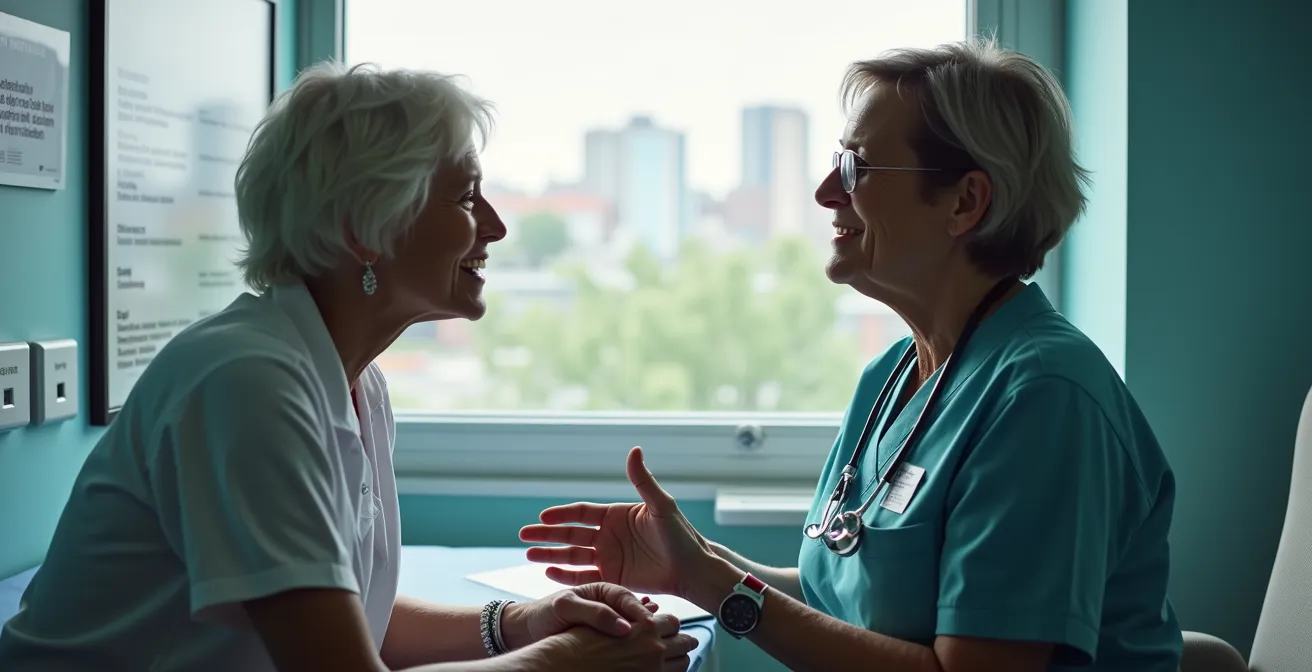
This is a moment of profound relief, where the weight of uncertainty lifts. It’s a feeling captured in the quiet space of a consultation room, where a doctor delivers reassuring news.

Knowing this statistic doesn’t eliminate the initial fear, but it can contain it. It allows you to hold the possibility of a benign outcome as a statistically probable reality. A Montreal-based cancer survivor who experienced this exact scenario shared their key coping strategy: « Focus on what you’re doing in the present, whether that’s cooking a meal, talking with a friend, or walking your dog. » This advice isn’t about ignoring the fear; it’s about anchoring yourself in the reality of the present moment while you wait for the facts. It prevents the « what if » from consuming the « what is. »
What Exercise Intensity Reduces Recurrence Risk by 30%?
While much of scanxiety management involves mental and emotional strategies, taking proactive physical control is a uniquely powerful component of your « Agency Architecture. » Exercise is not just a way to manage stress; it is a clinically proven strategy for improving outcomes. The question is no longer *if* you should exercise, but *how*. Groundbreaking research has provided concrete answers, transforming exercise from a vague recommendation into a specific prescription.
Case Study: The CHALLENGE Trial
The Canadian Cancer Society-funded CHALLENGE trial was a landmark study that enrolled 889 participants, primarily from Canada and Australia, who were survivors of high-risk stage III colon cancer. The results were profound: the group engaged in a structured exercise program showed a 28% lower risk of recurrence and a 37% lower risk of death compared to the group that did not. This wasn’t about training for a marathon; the intervention was a manageable 2.5 hours of moderate-intensity exercise per week. The activities were accessible and varied, including everything from brisk walking to pickleball, demonstrating that consistency is more important than extreme intensity.
This evidence is transformative. It means that engaging in moderate activity—like a 30-minute brisk walk, five days a week—is not just « good for you. » It is an active, evidence-based step you can take to reclaim a measure of control over your future health. It turns anxious energy into a productive, health-promoting action. In Montreal, with its numerous parks and community centers, integrating this level of activity is highly achievable. It shifts your role from someone who is simply being monitored for disease to someone who is actively building resilience against it.
The « Incidentaloma » Trap: Finding Benign Lumps That Cause Anxiety
Modern imaging is so powerful that it often finds things we weren’t looking for. An « incidentaloma » is exactly that: an unexpected, incidental finding on a scan that is unrelated to the original reason for the test. It could be a benign cyst on a kidney or a harmless nodule on the thyroid. While most are harmless, the discovery of a new, unknown « lump » can throw a survivor right back into the spiral of scanxiety. This is a critical test of your « Agency Architecture, » demanding a structured response rather than a fearful reaction.
The first step is to acknowledge the anxiety as a normal response. It’s a physiological echo of your cancer experience. The second step is to immediately pivot to a « Curated Information Diet »—replacing panicked Googling with a list of targeted questions for your medical team. Instead of asking « Is it cancer? », which is an unanswerable question at first, focus on gathering decision-making data. A useful framework for your conversation with your doctor in Quebec includes:
- Statistical Likelihood: « What are the statistical chances that a finding like this, in this location, is serious? »
- Risk-Benefit Analysis: « What are the risks of an immediate biopsy versus a ‘watch-and-wait’ monitoring approach? »
- Local Protocol: « What is the standard Quebec or MUHC/CHUM protocol for this type of incidental finding? »
- System Navigation: « Considering typical wait times in the Canadian healthcare system for further tests, what is our timeline? »
This approach moves you from a state of passive worry to active inquiry. You are no longer just the subject of a finding; you are a manager of the process, collecting the information needed to make an informed decision with your team.
How AI Helps Radiologists Spot « Invisible » Lung Nodules Early?
A common fear is that something small could be missed on a scan. The idea of a « hidden » nodule is a source of deep-seated anxiety. However, the field of radiology is undergoing a technological revolution that directly addresses this fear, and Montreal’s research hospitals are at the forefront. The integration of Artificial Intelligence (AI) into radiology is acting as a powerful new safety net for patients.
Think of an AI tool not as a replacement for the radiologist, but as a tireless, data-driven assistant with perfect memory. These algorithms are trained on hundreds of thousands of scans. They can detect subtle patterns, track the growth of tiny nodules over time with superhuman precision, and flag areas that might warrant a closer look. For a survivor undergoing follow-up scans, this is incredibly reassuring. As piloted in major Montreal hospitals like the CHUM and the Jewish General Hospital, these AI tools serve as a « second set of expert eyes, » reducing the chance of ambiguous findings that lead to stressful, repeated monitoring.
This advanced diagnostic capability is supported by robust infrastructure. An inventory of imaging equipment shows there are 10 PET scanners in Montreal alone, with more across Quebec. This combination of advanced technology and accessibility means that patients in the region are benefiting from one of the most rigorous monitoring environments available. Knowing that both human expertise and AI precision are reviewing your scans can be a powerful antidote to the fear of the « unseen. »
Key Takeaways
- Scanxiety stems from a loss of control; the antidote is to build an « Agency Architecture » by actively engaging with the healthcare system.
- Many anxiety triggers (rising tumor markers, lung shadows) are often benign. Knowing the statistics is a powerful tool against fear.
- The Quebec healthcare system has specific pathways for second opinions and supportive care that can be leveraged to increase your peace of mind.
How to Interpret « Guarded Prognosis » When Speaking to an ICU Doctor?
Few phrases from a doctor are as chilling as « guarded prognosis. » It is vague, ominous, and can leave families feeling powerless and confused. Learning to interpret this term is the final, crucial piece of « Prognosis Literacy. » « Guarded » does not automatically mean « hopeless. » It means the doctor is in a state of high uncertainty and is monitoring the situation very closely. It can represent a wide spectrum, from « cautiously optimistic but we’re not out of the woods » to « preparing for serious challenges. »
Your role is not to passively accept this ambiguity, but to ask clarifying questions that translate the term into concrete information. This is especially vital in high-stress ICU environments. You can ask:
- « What specific factors are making the prognosis guarded right now? »
- « What are the best-case and worst-case scenarios you are considering over the next 24 hours? »
- « What specific milestones or changes are you watching for that would make you more or less optimistic? »
In Quebec’s healthcare system, with an estimated 184 new cancer cases diagnosed daily, the need for clear communication is immense. Montreal hospitals have social workers and spiritual care services who are trained to act as mediators in these conversations, helping to translate medical terminology and provide emotional support. Do not hesitate to request their presence. They are a critical part of your support system, ensuring you understand the situation as clearly as possible, even when the outcome is unknown.
Building this « Agency Architecture » is a continuous practice. It’s about shifting your mindset from one of passive fear to one of proactive management. By understanding the system, decoding the language, and preparing for your appointments with a clear strategy, you reclaim control, one piece at a time.
Frequently Asked Questions About Navigating Cancer Care in Montreal
Can I receive palliative care while still receiving cancer treatment in Montreal?
Yes, absolutely. In Quebec, palliative care is often referred to as « supportive care » and it is designed to be initiated at any stage of your illness, alongside curative treatments. Its purpose is to manage symptoms like pain, fatigue, and anxiety to improve your quality of life during treatment.
What services do Quebec’s CLSCs provide for palliative support?
The CLSCs (Centre local de services communautaires) are vital hubs for community health. They coordinate a range of at-home palliative support services, including specialized nursing care, professional pain management, and psychological services, which helps reduce the burden on hospitals and allows patients to receive care in a comfortable setting.
Is palliative care covered by RAMQ?
Yes. Critical services offered by palliative care teams, such as psychological support, pain management consultations, and nutritional counseling, are covered by the Régie de l’assurance maladie du Québec (RAMQ).
What does ‘guarded prognosis’ mean in Quebec medical terminology?
‘Guarded prognosis’ is a term used by physicians to indicate significant uncertainty about a patient’s outcome. It covers a spectrum from ‘cautiously optimistic’ to ‘preparing for challenges.’ It essentially means the medical team is monitoring the situation extremely closely because the path forward is not clear.
What questions should I ask for clarity on a ‘guarded prognosis’?
To get more clarity, ask direct and specific questions. Good examples include: « What specific factors make the prognosis guarded? », « What are the best-case and worst-case scenarios you are preparing for? », and « What are the key milestones you will be watching for in the next 24-48 hours to have a clearer picture? »
What support services are available in Montreal hospitals for difficult conversations?
Montreal hospitals have dedicated support staff to help you navigate these high-stress moments. Hospital social workers and spiritual care services can act as crucial mediators, helping to translate complex medical terms, facilitate communication with the medical team, and provide essential emotional and psychological support to you and your family.