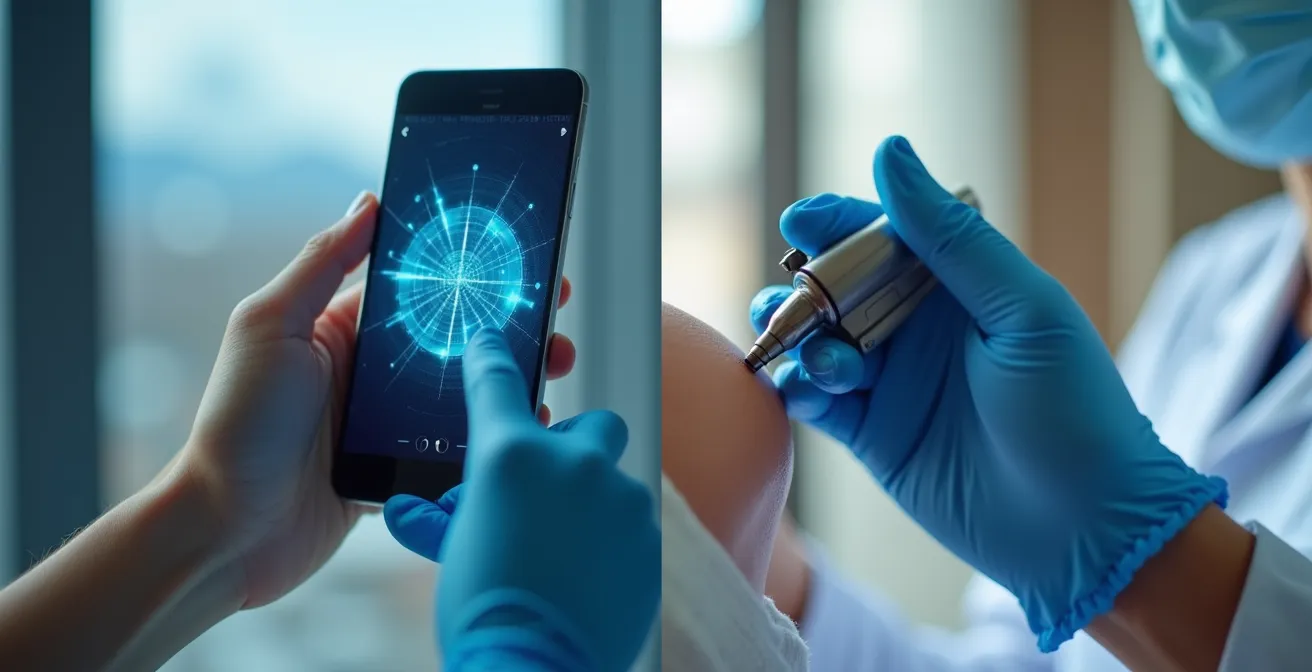
Contrary to the hype, an AI app’s accuracy for mole checking is not a simple number; it’s a complex issue deeply affected by hidden biases and the specifics of Canada’s healthcare landscape.
- AI models often show reduced accuracy on darker skin tones due to biased training data, creating significant « algorithmic blind spots. »
- Using these apps raises critical questions of data sovereignty, especially for Quebec residents under Law 25.
Recommendation: Use AI apps as a personal tracking tool, but for a diagnosis, trust the augmented intelligence of a physician who can provide clinical context and navigate the Montreal healthcare system.
You notice a new mole, or an old one that seems to have changed. The wait for a dermatologist appointment in Montreal can be long, and the anxiety is immediate. A smartphone app powered by artificial intelligence promises a fast, easy, and accurate assessment right from your living room. It seems like the perfect solution. The marketing often highlights impressive statistics, sometimes suggesting the algorithm is even more accurate than the human eye. This is the promise of AI in dermatology.
But this simple narrative of « app vs. doctor » overlooks critical questions. Is that impressive accuracy score valid for your specific skin tone? What happens to that intimate photo of your skin once you upload it, especially under Quebec’s strict privacy laws? The conversation shouldn’t be about replacing doctors, but about understanding the tool’s true limitations and its proper place within your healthcare journey. The real question is not just « Is it accurate? », but « What does accuracy truly mean in a world of biased data and complex medical realities? »
This article moves beyond the surface-level debate. We will dissect the performance of AI in various medical fields to build a more nuanced understanding. By examining AI’s role in detecting lung nodules, predicting cardiac arrest, and its well-documented biases, we will construct a realistic framework for evaluating that mole-checking app on your phone. The goal is to empower you to see AI not as a digital oracle, but as a powerful—and flawed—tool that is best used in partnership with a human expert.
To navigate this complex topic, we will explore the different facets of AI in medicine, from its remarkable successes in radiology to the ethical minefields of data ownership. This structured approach will provide the context needed to make an informed decision about your health.
Summary: AI in Medicine: Accuracy, Bias, and the Doctor’s Role
- How AI Helps Radiologists Spot « Invisible » Lung Nodules Early?
- Can AI Predict Cardiac Arrest Before It Happens in the Hospital?
- The Risk of AI Bias: Does the Algorithm Work on All Skin Tones?
- Who Owns Your Medical Data When It’s Used to Train AI?
- Augmented Intelligence: Why the Best Doctor Uses AI as a Second Opinion?
- How to Use Your Smartwatch to Detect Silent Atrial Fibrillation?
- The « Shadow » on the Lung That Turns Out to Be Scar Tissue
- 1.5T vs 3T MRI: Which Machine Should You Choose for Brain Imaging?
How AI Helps Radiologists Spot « Invisible » Lung Nodules Early?
Before we can critique the limitations of AI, it’s essential to understand its raw power in pattern recognition. In radiology, AI is not just a helpful assistant; it’s a superhuman scanner. Human radiologists, despite years of training, can miss minute details on a chest X-ray, especially when looking for something they aren’t expecting. An AI, however, can be trained to screen every pixel for signs of trouble, regardless of the initial reason for the scan.
This capability has led to a significant increase in incidental findings that prove to be clinically important. A retrospective study at Yongin Severance Hospital provided compelling evidence of this. The analysis showed that AI detected lung nodules in 1,754 cases (4.4%) out of 40,191 procedures from non-respiratory departments. These were patients being scanned for other reasons, where a small lung nodule might have been easily overlooked. This demonstrates AI’s core strength: tireless, unbiased pixel-by-pixel analysis to catch what the human eye might miss. It sets a powerful baseline for the technology’s potential.
This is the « best-case scenario » for medical AI—a well-defined task, a controlled data format (medical images), and a clear, positive impact on early detection. It’s this level of performance that fuels the development of consumer-facing apps for things like mole checking. The underlying principle is the same: use an algorithm to spot patterns that might signify a problem.
Can AI Predict Cardiac Arrest Before It Happens in the Hospital?
Moving beyond simple detection, the next frontier for medical AI is prediction. Instead of just identifying what is already there (like a nodule), algorithms are now being trained to forecast future medical events based on subtle changes in a patient’s data over time. In the high-stakes environment of an Intensive Care Unit (ICU), predicting a catastrophic event like cardiac arrest can be the difference between life and death. Here, AI analyzes a continuous stream of data—heart rate, blood pressure, oxygen saturation—to identify a « clinical trajectory » of deterioration that a busy nurse or doctor might not notice until it’s too late.
A groundbreaking machine learning study analyzing 23,909 ICU patients demonstrated this predictive power. The researchers found that their AI algorithm achieved an AUROC of 0.85 at 13 hours before a cardiac arrest event. (AUROC is a measure of diagnostic ability, where 1.0 is perfect and 0.5 is no better than chance). This is a remarkable level of foresight. As the study’s authors note, this shows the potential to act proactively rather than reactively.
Our model demonstrates it is possible to detect a trajectory of clinical deterioration up to 13 hours in advance.
– Lee HY et al., JMIR Medical Informatics study on ICU cardiac arrest prediction
This predictive capability in a controlled hospital setting, where data is high-quality and constantly monitored, is what app developers hope to translate to the consumer market. The idea behind a mole-checking app is similar: to not just see the mole today, but to predict its risk of becoming malignant. However, the clean, structured data of an ICU is a world away from a selfie taken in a dimly lit bathroom, a critical distinction we must not forget.

The visualization of this predictive power in a clinical setting underscores the controlled environment in which these advanced algorithms currently thrive. This context is key to understanding the gap between professional medical AI and consumer-grade applications.
The Risk of AI Bias: Does the Algorithm Work on All Skin Tones?
Here we arrive at the central problem for dermatology apps. The impressive performance of AI in controlled settings like radiology and the ICU often breaks down when faced with the diversity of the real world. An AI is only as good as the data it’s trained on. Historically, medical datasets, particularly in dermatology, have overwhelmingly featured images of lighter skin. This creates dangerous algorithmic blind spots.
When an AI trained predominantly on Caucasian skin is asked to evaluate a mole on Black, Asian, or Indigenous skin, its accuracy can plummet. This isn’t a minor flaw; it’s a critical failure that can lead to false reassurances for a dangerous melanoma or unnecessary anxiety over a benign lesion. Extensive research on algorithmic bias in dermatology reveals that AI models can show significant performance drops for individuals with Fitzpatrick skin types V and VI (which represent brown and black skin tones).
Recognizing this challenge is the first step. Some innovators are tackling it head-on. The Toronto-based developers of the GetSkinHelp app are a prime example of building a solution with diversity in mind from the start.
Case Study: GetSkinHelp’s Approach to Canadian Diversity
The SkinAI technology within the GetSkinHelp app claims 88% accuracy in screening for skin cancer, comparing favorably to the 66%–87% rate of trained physicians. Crucially, the app was specifically designed to address Canada’s diverse population. Furthermore, its services are integrated with provincial health plans like OHIP and RAMQ, meaning there are no out-of-pocket costs for users, removing a key barrier to access. This focus on inclusivity and integration into the public system is a model for responsible AI development.
Checklist for AI Fairness in Medical Devices
- Demonstrate algorithmic performance across all Fitzpatrick skin types.
- Include diverse Canadian populations in validation datasets.
- Provide transparency reports on model limitations and potential biases.
- Establish continuous monitoring systems to detect performance drift or emergent bias.
- Implement accessible feedback mechanisms for users from underserved communities.
Who Owns Your Medical Data When It’s Used to Train AI?
Let’s assume you’ve found an app proven to be unbiased and accurate. A new, equally critical question arises: who owns your medical data, and how is it used? When you upload a photo of a mole, you are creating a valuable piece of data. That data is used to provide your assessment, but it’s often also used to further train and improve the AI model. This raises significant questions about consent and data sovereignty, especially in a jurisdiction like Quebec with its robust privacy laws.
Quebec’s Law 25 (formerly Bill 64) grants citizens extensive rights over their personal information. This isn’t just about clicking « I Agree » on a long, unread terms of service document. Canadian law requires informed consent, meaning the app must clearly explain how your data will be used for research and development. You have the right to know where your data is stored (is it on a server in Canada or the US?), who has access to it, and how you can have it deleted. The cross-border flow of data can be particularly contentious, as it may conflict with provincial privacy regulations designed to protect Canadians.
The goal of many Canadian innovators is to leverage this data for good, within a secure and ethical framework. As leaders in the field point out, Canadian data can fuel Canadian innovation.
Skinopathy is a powerful example of how Canadian innovation fueled by research talent from our own universities can lead to smarter, more accessible healthcare.
– Dr. Stephen Lucas, Chief Executive Officer of Mitacs
While the potential for innovation is clear, the user’s rights must remain paramount. Before using any health app, you must consider whether the convenience it offers is worth the digital footprint you leave behind. Who truly owns this digital extension of your body?
Augmented Intelligence: Why the Best Doctor Uses AI as a Second Opinion?
After exploring AI’s power, its biases, and its data risks, we arrive at the most productive answer to our initial question. The debate should not be « AI vs. Doctor. » The future of medicine, including dermatology, lies in augmented intelligence: the synergy between a human expert and a powerful AI tool.
An AI can screen thousands of images and flag subtle patterns a human might miss. A doctor, however, can do what an AI cannot. They can talk to you, understand your family history, consider your lifestyle and sun exposure, and perform a physical biopsy. A doctor can interpret the AI’s output within the full context of you as a patient. A study highlighted a concerning trend: most international authors of AI skin cancer publications are non-dermatologists. This highlights a disconnect between the tech developers and the clinical experts, reinforcing the need for dermatologists to be at the center of this technological evolution, not on the sidelines.
The best physicians will not be replaced by AI; they will be the ones who master it as a tool. As Dr. Vishal Anil Patel, a leader in cutaneous oncology, puts it, AI enhances their capabilities.
AI is making us more precise, and we’ll be better at assessing a patient’s risk with the different tools we have.
– Dr. Vishal Anil Patel, Director of Cutaneous Oncology at GW Cancer Center
So, is an app as accurate as a doctor? The question is flawed. An app is a pattern-recognition tool. A doctor is an expert diagnostician and caregiver. The most accurate outcome will always come from a doctor who can leverage the tool’s insights without being blindly reliant on its output. The app can be a good first step for data gathering, but the final word must belong to the human expert.
How to Use Your Smartwatch to Detect Silent Atrial Fibrillation?
The dilemma of the mole-checking app is mirrored in the world of consumer wearables. Many smartwatches now offer features like ECG and irregular heart rhythm notifications, creating a new firehose of data for patients and doctors. It’s a powerful tool for detecting « silent » Atrial Fibrillation (AFib), a condition that can be asymptomatic but significantly increases stroke risk. However, like with dermatology apps, understanding the technology’s classification is crucial.
Not all features are created equal. Health Canada makes a clear distinction between a « medical device » feature, which has undergone rigorous validation, and a « wellness feature, » which has not. An ECG app on an Apple or Samsung watch is considered a Class II Medical Device in Canada, meaning its output can be considered reliable data by a physician. An « irregular rhythm notification, » however, is often just a wellness feature, acting as a preliminary screening that requires confirmation.
| Feature | Medical Device Status | Available in Canada | Clinical Use |
|---|---|---|---|
| ECG Recording | Class II Medical Device | Apple Watch 4+, Samsung Galaxy Watch | Can be shared with physician |
| Irregular Rhythm Notification | Wellness Feature | Most smartwatches | Screening only, requires confirmation |
| Blood Oxygen Monitoring | Wellness Feature | Apple, Garmin, Fitbit | Not for medical diagnosis |
This distinction is vital. A mole-checking app that hasn’t received a medical device designation from Health Canada is, in essence, a wellness feature. Its results should be treated as a prompt to seek expert advice, not as a diagnosis in itself. If your wearable does provide a concerning reading, the next step is not to panic, but to engage with the healthcare system in a structured way, for instance by using a service like Rendez-vous Santé Québec to book a telehealth appointment.
The « Shadow » on the Lung That Turns Out to Be Scar Tissue
The power of AI lies in its ability to see patterns, but its greatest weakness is its complete lack of real-world understanding. It sees pixels, not patients. A perfect illustration of this is the « shadow » on a lung scan. An AI algorithm, like the ones that are so effective at spotting early nodules, might flag a suspicious area on a chest X-ray. From a purely pattern-recognition standpoint, it might have all the characteristics of a malignant tumor.
However, a human radiologist brings something more: context. They can access the patient’s file and see a history of pneumonia in that same lung five years ago. They understand that severe infections can leave behind scar tissue (granulomas), which can appear on a scan as a « shadow » that mimics cancer. The AI sees a threatening pattern; the doctor sees a ghost of a past illness.
This scenario is the perfect metaphor for the risk of over-reliance on dermatology apps. An app might flag a mole as « high-risk » because it shares certain visual characteristics with melanoma. But a dermatologist might recognize it instantly as a seborrheic keratosis—a benign, common growth that can look alarming to an untrained eye (or algorithm). The AI delivers a result; the doctor delivers a judgment based on a wealth of experience and patient context. This is a gap that technology, in its current form, simply cannot bridge.
Key Takeaways
- AI’s diagnostic accuracy is highly dependent on the quality and diversity of its training data; models trained on limited datasets may fail on different skin tones.
- The true power of medical AI lies in « augmented intelligence, » where it serves as a powerful second opinion for a human expert, not a replacement.
- In Canada, and especially Quebec, users must be aware of data sovereignty issues (Law 25, PIPEDA) and understand how their personal health information is stored and used.
1.5T vs 3T MRI: Which Machine Should You Choose for Brain Imaging?
Finally, let’s bring the discussion back to the ground level of the healthcare system in Montreal. Even with a perfect AI-driven risk assessment of your mole and an immediate referral from your doctor, the next step involves navigating the practical realities of diagnostic imaging and specialist access. The choice of technology and the wait times associated with it are a crucial part of the patient journey that an app cannot manage.
Consider the choice between a 1.5T and a 3T MRI for brain imaging. A 3T MRI offers higher resolution, but is it necessary for every case? As the Canadian Partnership Against Cancer notes, AI can automatically suggest the optimal scan type (1.5T vs 3T) based on the diagnostic question, optimizing resources. However, the final decision rests within a system of limited access. A physician’s role extends to navigating this system. They can weigh the clinical need for a high-resolution 3T scan against the much longer public wait times or the significant out-of-pocket cost at a private clinic in Montreal.
| MRI Type | Public Wait Time | Private Clinic Cost | Best Use Cases | AI Enhancement Available |
|---|---|---|---|---|
| 1.5T MRI | 4-6 months | $700-900 | General brain imaging, routine scans | Yes – AI upscaling improves image quality |
| 3T MRI | 6-9 months | $1200-1500 | Detailed brain studies, research protocols | Yes – AI assists in protocol selection |
| Open MRI (0.7T) | 3-4 months | $600-800 | Claustrophobic patients | Limited AI support |
This is the final piece of the puzzle. The doctor’s role is not just to diagnose. It is to be your expert guide through the complexities of the healthcare system—a system of trade-offs, wait lists, and resource allocation. An AI app can give you a data point, but it cannot devise a holistic care strategy for you within the specific context of the Quebec health network.
Therefore, the question of whether an app is as accurate as a doctor is ultimately the wrong one. The right question is: how can we use this powerful new technology as a tool to enhance, not replace, the expert, contextual, and deeply human judgment of a physician? Treat the app on your phone as a sophisticated diary for tracking changes, a tool to bring more data to your next appointment, but always place your trust in the hands of a healthcare professional. For a definitive answer and a clear path forward, the next step should always be a consultation with your doctor.
Frequently Asked Questions About AI in Dermatology
What happens to my skin photos in AI health apps under Quebec’s Bill 64?
Quebec residents have specific rights including access to their data, knowledge of where it’s stored, and the ability to request deletion under Law 25 provisions.
Can Canadian health data be stored on US servers?
Cross-border data flow may conflict with provincial privacy laws; apps must comply with PIPEDA and provincial regulations for data sovereignty.
Is clicking ‘I Agree’ sufficient consent for AI training use?
Canadian law requires informed consent that clearly explains how data will be used for R&D, not just standard terms acceptance.